

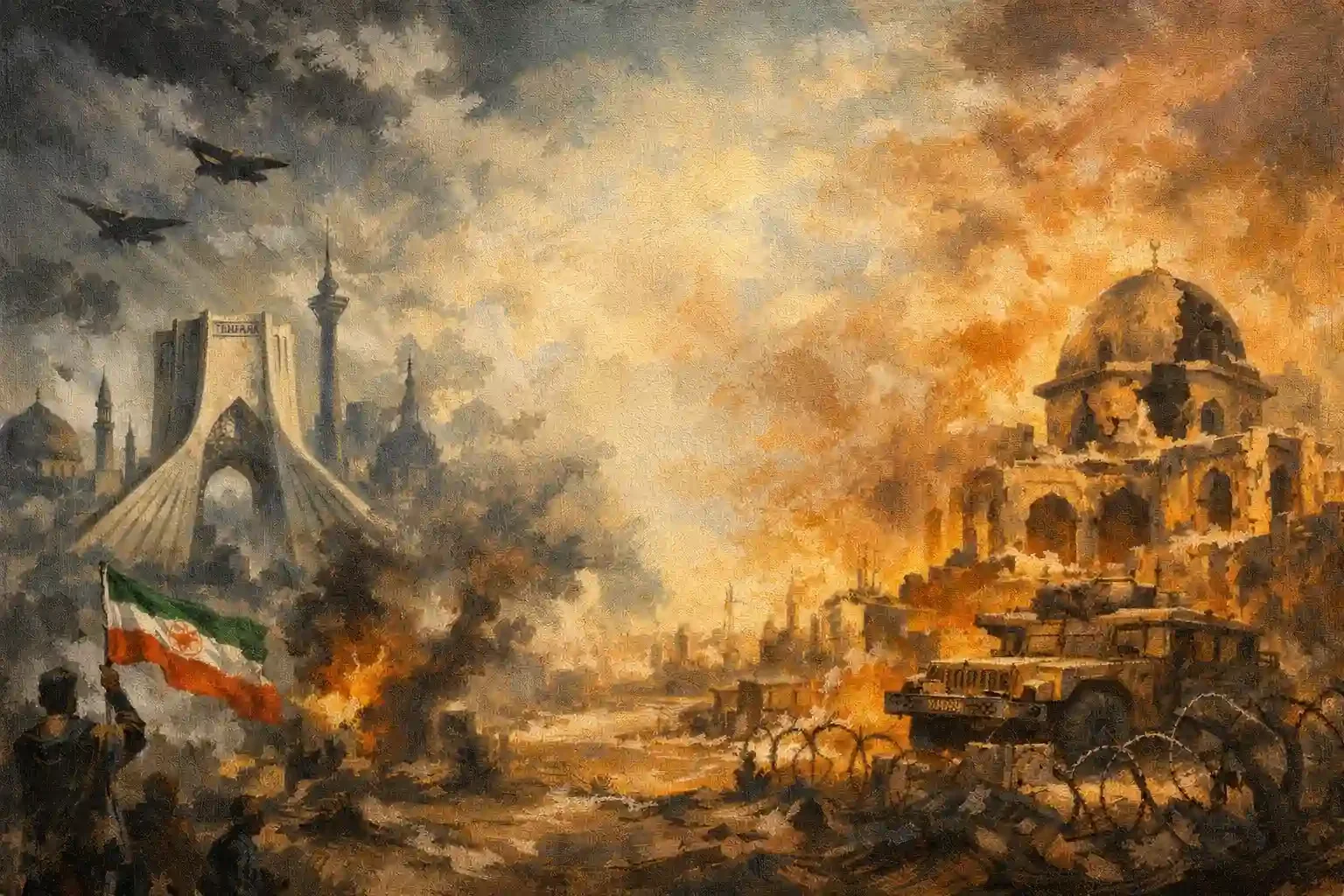
The specter of the devastating failures in Iraq are leading to the same mistakes in Iran, but the lessons we learnt were probably the wrong ones.
Say what you like about the Iraq War (and who doesn’t?), the US went in removing Saddam Hussein fully in the knowledge that they would have to occupy it and nation-build. There was no illusion that they could just bomb Baghdad, kill the Ba’athist leadership, and hope that the Iraqi people would rise up against the state apparatus that had kept them oppressed for over 40 years. Where the Bush administration went terribly wrong was not in the vision of what needed to be done, but the extent to which they would need to be involved to do it. The great failing was trying to leave too soon and not committing to the long task of nation-building, which the US—under the impression that, although powerful, it was capable of anything—was not actually equipped either financially or politically to do (Los Del Rio’s Macarena aside).
Indeed, the political restriction was perhaps the most damaging when it came to rebuilding Iraq. Given the radical and utopian nature of the project to remove Saddam Hussein and build Iraq up as a secular republic, it was obviously a divisive policy. Whereas the war in Afghanistan could clearly be justified on the basis of defense after the 9/11 attacks, the American (and British) people were more divided on whether preemptive action was too risky or not. This political complexity made the anxiety of a speedy exit from Iraq more intense and premature. The prematurity of the Obama withdrawal (at the demand of al-Maliki) ultimately resulted in the ISIS surge that was mirrored ten years later in the withdrawal from Afghanistan.
The haunting ghost of failure of the Iraq War is no doubt playing in the mind of the Trump administration over its strikes against the clerical regime in Tehran. Wanting to avoid boots on the ground to avoid looking like they are making the same mistakes as the Bush-era utopianism, the US’s strikes on Iran are making all new ones. While the Bush administration was under no delusions that a full-on military invasion and occupation was necessary for achieving its noble (though fanciful) aims in Iraq, the Trump administration seems to think that following the Obama “half in, half out” strategy—that caused much more anguish than necessary in both Libya and Syria—will allow him to preserve his backing at home while also dealing with the threat that Tehran has posed for many years.
Of course, this will turn out to be complete madness. For as long as the Trump administration avoids the necessity of a full-on invasion and a forced regime change in Iran, it will only result in a weakened but more hardline enemy and far more civilian casualties in the long run. And as the days slip into weeks, the window of opportunity that the US and Israel (and the wider region) has will be missed, and the regime will only spend time rebuilding itself. It will also be proven to be a poor domestic political strategy for the Trump administration. Trying to avoid pissing off anyone by avoiding a firm commitment to any side of an argument will also lead you to a tighter spot in the future than taking the difficult decision now. As Machiavelli astutely warned, remaining “neutral” and not intervening “in favour of one side and fight[ing] strongly” will always backfire.
Perhaps the sadder point that is implicit in the US-Israeli actions is the unilateralism over the conflict. Despite the deep misgivings of the Bush administration over the United Nations, at the behest of Tony Blair, it is did try to both build a coalition to overthrow Hussein and try to go through the UN to get backing for the action. It was not unilateral action despite being lacking international legitimacy. However, the US intervention against Iran and Trump reserving a role as some international king-maker, has made no attempt to build such a coalition, and given their behavior over Greenland, it’s not surprising. But, for the wider humanitarian and democratic cause that is supporting the Iranian revolution, either way the international community is not there for them. Indeed, if Europe had joined the US and Israel in the endeavor to liberate the Iranians and help them create the democracy they deserve, the moral action would have far more legitimacy even without UN backing.
I have never been a fan of airstrikes in general, and it has always baffled me as to why Western commentators seem to prefer them to forces on the ground. While it is true that airstrikes are less risky both politically and in terms of security for servicemen and women, the reality is that they are far more damaging and indiscriminate, no matter how well you aim. As recent reports are indicating a U.S. strike may have wrongly hit an Iranian girls’ school (despite raising serious questions of US competence), the mistakes made from the air are far more devastating than could be verified on the ground. In the fight against Islamic State, while we committed serious efforts in terms of air power, it was ultimately the Kurds who fought the battles with the terror group. Even at the time, it was confusing to me as to why, faced with an organization that had openly declared war against the US and Europe (as well as Russia, let’s not forget), we decided not to commit troops on the ground to fight side by side with our Kurdish allies to support them properly. My concern is not that airstrikes are immoral or ineffective, but that they are often used as a political substitute for strategy. They are too weak to push an entrenched regime to collapse and destructive enough to deepen the long-term human and political costs.
As I said last week, this war has always been unavoidable, given the regime’s ideological goals and behavior over the last few decades. It is also morally right to intervene on the side of the Iranian people against the repression they have faced and hated for too many years. But our political reluctance to do the job properly will not result in victory, but even more anguish in the future. Even in Israel, where military action against the mullahs and regime change are popular, Netanyahu’s government is employing all the political spin tricks in order to mitigate the fallout of an undercommitted US. “You can lead someone to water,” says Netanyahu, but you “can’t make him drink,” as he faces the uncertainty that the Iranian people, after being massacred by the regime back in January, might need a little more help than is willing to be given in order to overthrow their regime.
Well, Bibi, you can certainly lead them to water, but if you or anyone else cannot commit to a full and necessary course of action, you will ultimately end up in long-term failure.
Ultimately, the case I’m making is quite the opposite of the liberal-cautious or the so-called “realists.” While I personally think that disruption in the world’s economy is worth the liberty of the Iranian people, it would be needless if that liberty is not attained. The question is not whether we should or shouldn’t support action in principle against the regime (because it’s hard to argue the latter), but those of us who believe in a democratic Iran ought to be pushing to put an end to the regime once and for all. It would be a much stronger long-term strategy than this directionless effort to reverse bully the regime into good behavior; it just won’t happen and will in fact work against US interests. As we have even witness during this week, the regime is much more consolidated that I think many previously thought (including myself, per my article last week). Though I do not think the specter of devastation in Iraq is irrelevant, I think the lessons from it are not the ones that most people take away. But I also see Iran as different when it comes to risk, and it is even similar in that degree to Venezuela. The Iranian people have a much longer-standing semi-democratic tradition than the Iraqis ever did and, if the opposition could consolidate itself properly with a proper plan for transition, Iran could be stabilized quicker and without repeating the errors of de-Ba’athification.
However, I am increasingly more pessimistic that this will be Iran’s democratic moment, and the inertia from the last few months will perhaps be yet again just another non-definitive chapter along the road for the eventual liberation of the Iranians.
Trump running his mouth off at Netanyahu is probably justified, but the US president is really at fault for the disastrous intervention against the Iranian regime.