

Home / Reviving Mazzinianism / What is Mazzinianism?
What is Mazzinianism?
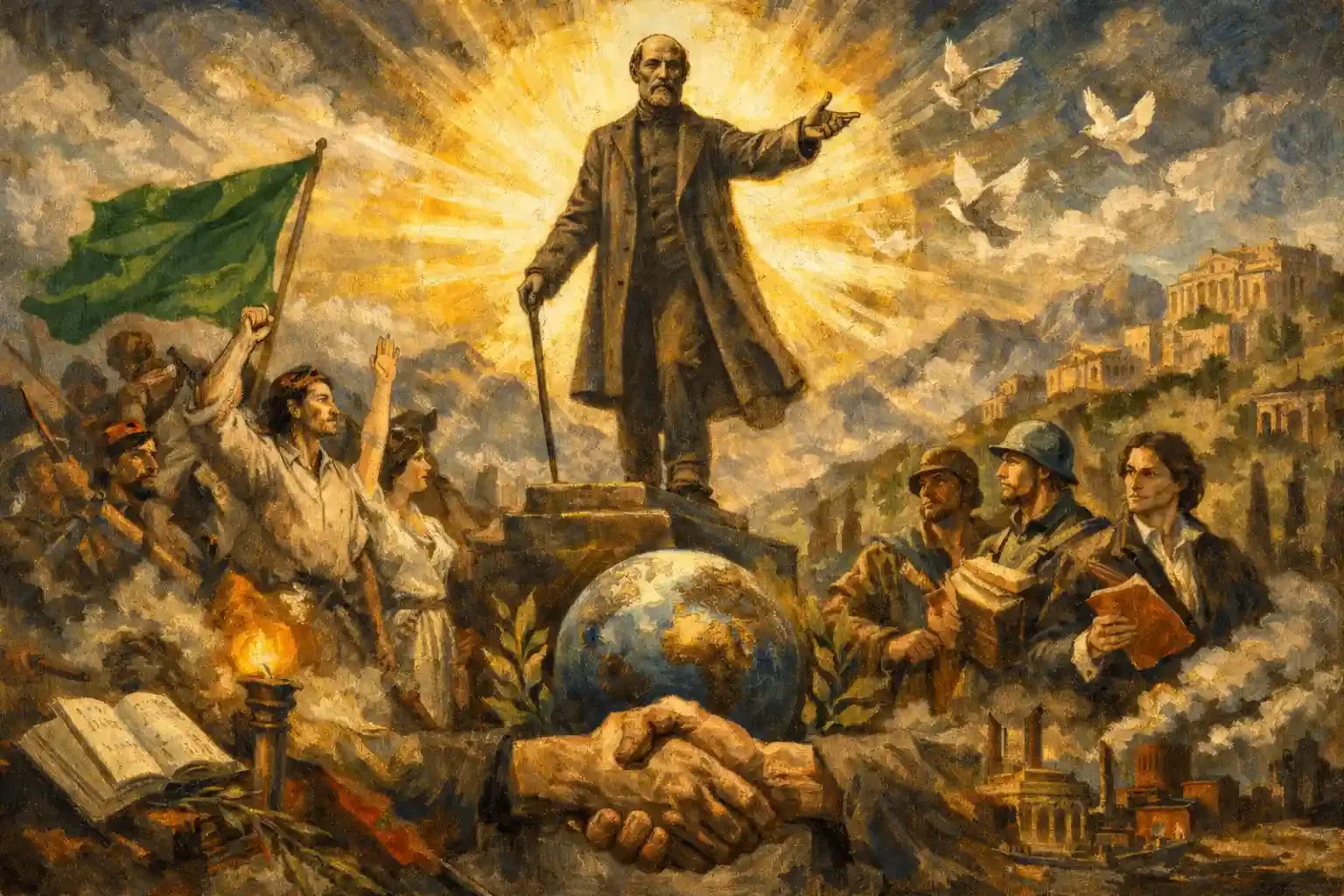
Written by David Tait | Last Updated on August 15, 2026
The principal project of the New Mazzinian is to help construct and inspire a revival of Mazzinianism as a political movement. While Mazzini has been gone for over 150 years, his thought still has resonance today.
Mazzinianism is derived from the political thought of Giuseppe Mazzini, a 19th century Italian revolutionary who was active during the Italian unification movement, Il Risorgimento. Though Mazzini left behind a great deal of his own political thought, principles and ideas and has found influence in Italy, there has never been an international Mazzinian school of thought or definitive “Mazzinianism”.
However, as the political world is currently going through a dramatic shift, Mazzini’s ideas concerning the nature of duties and the nation are becoming more relevant. Rights-based doctrines and globalization are running their course, and there is an opportunity for revitalizing the need for democracy and nations in a way that is neither superficial nor reactionary. Mazzinianism is the attempt to respond to this.
Mazzinianism seeks to provide an alternative to the rise of populism-vulgarism on the right and identitarianism on the left, without losing the progress that we have achieved. Mazzinianism strongly emphasizes the principle of unity to overcome our growing sectarian divisions and that we need to look more to our duties to give our rights direction.
Table of Contents ▼
Understanding Mazzinian Principles
Mazzinianism is a political doctrine that is based around the principle of democratic nationality. While it seems like the world was moving away from national divisions, Mazzinians believe that nationalities are essential for connecting the sole individual to the rest of humanity. Democratic nationality, therefore, is the missing bridge that other political doctrines miss when advocating for political action.
Unlike nationalism, where the nation is an end in itself, Mazzinianism regards nationality as a means toward its ultimate end: humanity. Mazzinians therefore reject all ethnic, racial, or sectarian conceptions of the nation in favor of one built around the shared principles of a people. Distinctions in language and culture, while indicative of nationality, must also be bound together by a shared moral goal.
Mazzinianism cuts across the modern political spectrum, incorporating ideas from both the left and right. On one side, it maintains a strong focus on social policy, advocating the involvement of the state in economic affairs and social welfare. On the other, it emphasizes the need for individuals to act through their nationality and fulfill their duties toward their fellow citizens and, by extension, the rest of humanity.
Lastly, Mazzinianism is a democratic internationalist doctrine that strongly supports all pro-democracy groups and movements around the world. It is intolerant of all forms of tyranny and totalitarianism and believes in confronting them directly. Mazzinians regard human rights as universal and hold that it is the duty of societies that have achieved democracy to help others in the same endeavor.
Here's an overview of the key Mazzinian principles:
Nationality & Nation: At the heart of Mazzinianism is the principle of democratic nationality, the belief that individuals best serve humanity by acting through their national identity. A nation represents a specialized workshop for humanity in which individuals can act toward a greater universal end. For Mazzinians, the nation is not the end in itself (as it is in nationalism) but rather the means to that end, with the true goal being the broader progress of humanity toward democracy and away from tyranny.
Duties & Rights: Mazzinianism holds that individual rights, though important, exist in service of individual duties. These duties are not defined by arbitrary religious or ideological dogma, but by the self-determined potential of free individuals who work together within society to advance humanity.
Humanity:If nationality is the means, the goal for Mazzinianism is humanity. Humanity is not just the static collective of human beings, but an active principle toward which our duties should be oriented. Humanity is essentially the realization of progress as we move from one moral stage to another and is contrary to any form of utopianism.
Republicanism: Mazzinianism’s main political vehicle is through the political philosophy of democratic republicanism. Not merely anti-monarchism, democratic republicanism belongs to the same classical republican tradition, seeking to establish a society with active citizens who are engaged in civic virtue and opposing corruption. Democratic republicanism provides for a powerful critique of liberal individualism and advancing the cause of liberty as non-domination.
Democracy: Mazzinianism upholds democracy above all other political systems. For Mazzinians, democracy provides both a necessary check against tyrannical rule and the means through which citizens can fully express their capacities and choices through liberty and community. Contemporary Mazzinians take a pluralistic view of democracy, respecting its many different forms, from parliamentary constitutional monarchy to presidential republics.
Unity: Mazzinianism places strong emphasis on unity in response to growing sectarianism and political polarization. For Mazzinians, unity is a guiding concept that orients a free people in their shared duty to work together for the common cause of the nation and, by extension, of humanity as a whole. Mazzinians understand unity as grounded in pluralism rather than conformity, and firmly believe that freedom and equality for all members of the nation are preconditions for genuine unity.
Anti-Totalitarianism: Mazzinianism is staunchly anti-totalitarian in all its forms and desires to challenge any form of tyranny directly and forcefully. Mazzinian anti-totalitarianism is based on the totalitarian rejection of liberties and pluralism that deny the individual not just their rights, but the ability to work toward their duties. Mazzinianism regards any form of sectarian-based politics as totalitarian in essence.
Revolution: Mazzinianism is a revolutionary doctrine, but not in a utopian or materialist way. Instead, revolution for Mazzinians is a pragmatic step for achieving progress and can take on differing forms depending on the nature and need of that progress. Revolution can either take form through democratic means through the ballot box, or the need to literally fight to oppose tyrannical regimes. For Mazzinians, the only true revolution is one based on principle.
Economics: Mazzinianism generally favors a mixed-economy approach, guided by a considerable degree of economic pragmatism. On the whole, however, Mazzinians look to Mazzini's own prescription as a framework for organizing the economy: "the union of labor and capital in the same hands." Mazzinianism therefore advocates for small business ownership, cooperative associationism, and sound macroeconomic management in the areas of employment and social policy.
Social Policy: Mazzinianism advocates social policies that provide individuals with the ability to take on their duties. The state, therefore, is considered to have a key role in setting an example in leading in its duties and rejects both paternalism and laissez-faire as adequate approaches. Mazzinians regard any policies aimed at fostering unity and collaboration as essential.
Internationalism: Mazzinianism takes a principled stance on foreign policy, rooted in a firm belief in democracy and a strong opposition to totalitarianism, allying themselves strongly on the side of the international democratic opposition. Mazzinians see the central conflict in foreign affairs as one between the forces of democracy, including individual liberty and justice, and those of tyranny. At the same time, Mazzinians believe in pragmatic alliance building and realistic methods for both promoting democracy and countering totalitarianism.
Why the Neglect?
The reason for the neglect of Mazzini's political thought is mostly down to the way history ended up playing out for him. Though he did rise to international fame at the height of the revolutions that swept through Europe in 1848, which saw him as the triumvir of the brief Roman Republic, the failure of the republic at the hands of the French also saw Mazzini's influence in the European democracy movement falter.
Waning Success
Despite this political failure, Mazzini had other problems that precluded his eventual vanishment and confinement to Italy political history. His style of romantic nationalism was quickly losing ground to the growing communist and socialist movements that were better articulating the grievances of the working classes experienced by the masses. Mazzini's movement, though consistently in favor of the working classes and their emancipation, drew most of its support from the educated middle-classes.
But it was also Mazzini's own anti-communism that would ensure his future political insignificance. Implacably opposed to class conflict (or any sectarianism of the sort), Mazzini emphasized the need to class collaboration through duty, that would enforce his concept of association through the nation. Mazzini was also strongly opposed to (Marx's) materialism, which he regarded as the erasure of noble and religious principle to wants, condemning it as "the worship of Interest, [that] would inevitably bring you down to egotism and anarchy." (The Duties of Man).
Communism and Fascism
Mazzini's anti-communism reached its crescendo in his harsh criticism towards the Paris Commune of 1871. Horrified by the "“the orgy of anger, vendetta, and bloodshed”, Mazzini wrote a scathing essay attacking the commune from emerging from a narrow, Parisian self-interest (The Commune and the Assembly, 1871). He called on the democratic movement to distance itself from associating itself with the Commune and desired Italy to show the world an alternative. However, this sentiment was not shared by the rest of the pro-democratic community, who were mostly in favor of the action in the Commune, and were puzzled by Mazzini's outrage. This ultimately marked a further step towards Mazzini's irrelevance today in the realm of ideas.
The more significant reason for Mazzini's neglect would come during the 1920s when the Partito Nazionale Fascista, led by Benito Mussolini, would come to power in Italy, ending the short-lived liberal(ish) democracy Italy had managed to form. The Fascists, particularly the self-proclaimed "philosopher of fascism", Giovanni Gentile, actively set about to mischaracterize and twist Mazzini's deeply held principle of national mission to support aggressive Italian chauvinism and imperialism. The revanchism of an even more vicious form of monarchism in Il Duce was so incompatible with what Mazzini believed when it can to democratic republicanism, that it is surprising that Mazzini could ever been credibly associated. Indeed, one of the most consistent opponents and activists against the Fascist regime, Carlo Rosselli, was himself inspired by Mazzini in his action against Mussolini.
The Man
Yet the most damning reason for Mazzini's obscurity today is down to his own qualities as a thinker. Mazzini was not a systematic theoretician who created complex philosophical explanations for history or his own political values. His writing is occasionally inconsistent, and his ideas sometimes lack the rigor that a Marx, a Mises, a Hegel, might have. Mazzini's faith was his philosophical system, and his devout religious faith, given to him by his mother, influenced his fierce belief in his principles and his devotion to good and duty. But it's also true that it makes almost impossible for his ideas to attain any mass appeal today.
The State of Modern Mazzinianism
Given the neglect of Mazzini’s thought, the state of modern Mazzinianism is relatively poor. While in Italy there is a great deal of intellectual work that has focused on reviving Mazzini’s ideas, on a global level, Mazzinianism does not have a following.
Contemporary Mazzinianism in Italy
Though Mazzinianism is virtually non-existent on the global scene, Mazzinian political thought continues to be a minority intellectual current in Italy. The Associazione Mazziniana Italiana (AMI), which was founded clandestinely in Milan during the anti-fascist Resistance in August 1943, has been the primary vehicle for Italian Mazzinianism in Italy and in Europe for over eight decades.
AMI, through its political journal Il Pensiero Mazziniano, has become an open forum for debating Mazzinian ideas, and has regularly commented on global affairs all the way from the end of the Second World War to the present day. Il Pensiero Mazziniano has dedicated itself to updating Mazzinianism for the modern day, committed to interpreting Mazzinian principles in contemporary terms across the fields of education, culture, and social regeneration. While written purely in Italian, Il Pensiero Mazziniano has maintained Mazzini’s original internationalism and writes regularly in favor of a federal United States of Europe.
Il Pensiero Mazziniano has been a major influence on The New Mazzinian and many of the ideas expressed about Mazzini’s political thought coincide with those of the contributor to the Italian journal. That being said, The New Mazzinian arrives at its own conclusions and is not a one-for-one translation of the debates and ideas expressed in Il Pensiero Mazziniano. The New Mazzinian currently does not have any relationship with AMI.
Mazzinianism has played a key role in Italian post-war politics, with the Italian Republican Party (PRI) aligning with Mazzinian republican ideals. In a nod to Mazzini’s influence, the party adopts the ivy leaf as its symbol, which is what Mazzini used to represent Young Europe.
Mazzinianism Elsewhere
While Mazzinianism has never existed as a global political movement, many political thinkers, actors, and movements throughout history have exhibited the same spirit as Mazzini’s ideas, either by direct influence or coincidentally. These individuals and movements, while not strictly speaking Mazzinians, represent a para-Mazzinianism that had a similar emphasis on republican government, nationality, and civic duties. The most significant examples of para-Mazzinians would be the Chinese republican revolutionary Sun Yat-sen and the Indian independence activist Mahatma Gandhi, who, while differing substantially with Mazzini, promoted similar ideas.
The New Mazzinian’s Dual Missions
The New Mazzinian seeks not just to revive Mazzinianism or to simply translate the Mazzinian ideas and debates in Italy, but to make it into an international political movement. While Il Pensiero Mazziniano has been a major influence, The New Mazzinian wants to build a more general form of Mazzinianism outside of the Italian context and incorporate ideas from other para-Mazzinians throughout history. The goal is to build a foundation of Mazzinian thought by building the intellectual basis of nationality, humanity, and duties, in order to make it more universally applicable (all while avoiding watering it down).
At the same time, The New Mazzinian wants to help foster the development of different national Mazzinianisms. Since Mazzinianism emphasizes the intellectual and political contribution of different nationalities, each nationality will derive its own Mazzinian tradition from its own historical, cultural, and social contexts. This means that while there is a unity of values in an international Mazzinianism, different countries will develop their own Mazzinian expressions through their own lens. The New Mazzinian seeks to lay the groundwork that future Mazzinian movements in different countries can use to derive their own flavor of it.
Why Mazzinianism Matters Today
It is clear that we are currently going through a political interregnum on a grand scale in our politics. The old paradigm that we have been used to—conservatism vs. socialism, capitalism vs. communism, and the dominant liberal international order—is collapsing around us, and the repercussions of this collapse are felt all around the world as many different political and demagogic forces are emerging to succeed it.
From Material to Belonging
While the character of this new political age is still up for grabs, it’s clear we are moving away from economically dominant politics to a politics where the question of home and belonging will become the main concern. The question of maximum individualism—on a global scale—has been met with fierce blowback by movements that are putting communal feeling first, even before economic efficiency. The first and clearest example of this was the Brexit referendum in 2016, where the primary case for leaving was not about economics, but sovereignty. COVID-19 also marked an important and organic expression of social solidarity, as when lockdowns commenced, many people sang their national anthems in support and comfort for one another.
Since then, many political movements have been springing up during this period of political turbulence. From left-wing and right-wing populism, to feeble conservatism, to nostalgic libertarianism and classical liberalism, to strongman vulgarism, to neoreactionary and alt-right ideologies, to radical intersectionalism, to liberal reactionaries, and all manners of racialist politics. It is clear that the debate over capitalism and socialism is over, with many economic questions now becoming subordinate to the question of home.
The Paradigm Shift
As this is a paradigm shift, it is difficult to see how this will look on the other side. To use the phrasing of Thomas S. Kuhn from his Structure of Scientific Revolutions, "ducks will look like rabbits" after the shift has finished. For example, the question of nationalism has never fit well in the collapsing paradigm, as there have been left-wing nationalists and patriots just as much as there have been right-wing ones. But it simply hasn’t fit well with the prism through which we see politics. However, this shift could bring us to a point in which the nation becomes a rabbit and economics, a duck.
Already some political ideas are doing this, from postliberal conservatism to Maurice Glasman’s Blue Labour movement in the UK; all of these are proposals for the theme of the next paradigm.
Where Mazzinianism Comes In
An interregnum, as Antonio Gramsci described, is a period where all sorts of morbid symptoms can appear. Many of the proposals for the next paradigm have appeared from resentment and anger as society has become more sectarianized, though it is only because a viable idea is yet to come to replace it. The danger is that it is replaced by an idea that might destroy all the progress we have made in the previous one.
Mazzinianism is another political proposal that seeks to play along the theme of belonging and consolidate a revolutionary doctrine that keeps us progressing. The old individual and rights-based paradigm is dying, but what replaces it should integrate the good while mitigating the bad. Mazzinianism, by promoting a system of harnessing the individual with their nationality for the benefit of humanity, hopes to be an agent for the future and for the good. We want to follow and expand that feeling of national and internationalist solidarity that we’ve seen emerge in times of crisis and make it the primary driver of social, economic, and political change.
Differences Between Mazzini and Modern Mazzinianism
Since we are adapting Mazzini’s thought for the modern day, it is inevitable that there will be differences between Mazzini’s original ideas and the movement today. Here’s a table comparing the key differences between Mazzini’s ideas and today’s intepretation:
| Key Idea | Mazzini’s Thought | Modern Mazzinianism |
|---|---|---|
| Nationality | Nationality was the principle that bonded groups of individuals together and served as the bridge toward progress and humanity. Mazzini regarded nationality as transient and transitory, believing that nationalities working together would eventually lead to international governance. | Nationality remains a core principle and the bridge toward progress and humanity, allowing individuals to connect with others globally. However, there is general skepticism that nationalities will ever be superseded; they will likely always exist. |
| Democracy | Democracy was synonymous with republicanism, relying on a Rousseauvian interpretation that sometimes overlooked pluralism for the sake of unity. | Democracy can manifest in many different valid systems. There is a strong belief in representative democracy and political pluralism as essential for progress. The nation is the common ground upon which this pluralism can exist without becoming sectarianism. |
| God | Strong theism. God provided the entire ethical framework and was the main source of nationalities and duties. Occasionally theocratic in tone. | Belief in God is helpful but inessential. The ethical frameworks of Mazzinianism can be understood with or without God. It is open to other religious and non-religious lines of thought that share the same principles, as long as there is a belief in an objective moral order. |
| Economics | Early social democratic thinker with a belief in some state involvement. He remained liberal regarding market mechanisms but believed the rich should help the poor out of duty. Guided by the principle of the “union of labor and capital in the same hands,” with a strong focus on the middle and working classes. | Guided also by the principle of the “union of labor and capital in the same hands,” with a focus on middle-class consciousness. Open to multiple economic schools of thought that advocate for strong macroeconomics and microeconomics without relying exclusively on one or the other. |
| International Relations | Early proponent of liberal internationalism and a principled foreign policy. Justified intervention on the basis of deterring despots and promoting democracy. Skeptical of cynical non-interventionism and pure cosmopolitanism. | Represents a spectrum between liberal internationalism and democratic realism. Intervention based on the principle of promoting democracy is seen as both a moral and strategic imperative for fighting totalitarianism. |
| Revolution | Violent revolution was necessary for fighting despotic regimes; however, he was strongly against terrorism, providing a strict set of rules for conducting guerrilla warfare. Revolution needed to be accompanied by social change, not just a change in government. True revolution could only be achieved on principle. | Revolution is contingent on the political situation. In the face of tyrannical regimes, a violent revolution—unless change is otherwise achievable—is often justified. Strongly anti-terrorism and against any attacks on civilians. Where existing democratic methods are available, violence can never be justified, and democratic revolutions (i.e., through the ballot box) are preferred. |
Mazzinianism Compared to Other Political Ideologies
Mazzinianism is a distinct political conception that emphasizes universal civil duties and the role of the nation in working toward humanity. However, it has significant overlaps and similarities with other political doctrines and movements, and it is worth giving a general overview of what Mazzinianism shares with each and where it diverges.
Political Ideologies that Share Traits with Mazzinianism
Here is a list of ideologies that Mazzinians share certain political traits with but ultimately diverge from:
Liberalism: Mazzinians share the liberal emphasis on individual rights and liberties but strongly disagree that they ought to be the end of human society. Mazzinians see rights as a means toward better achieving their duties toward the nation and humanity. They also share liberalism’s universal applicability of human rights, but argue that democracy and liberty need to be fought for through our duties.
Socialism: Mazzinians share many traits with socialism when it comes to the principle of association and economic justice, however they diverge on the materialist conception of history and society, placing a greater emphasis on spiritual unity and class collaboration.
Social Democracy: Mazzini could be described as a very early social democrat given his own belief that the state should intervene in the economy to provide education and other social services. However, Mazzinians generally diverge on the social contractual nature of social democracy, preferring instead a social covenant that is based on mutual duties.
Christian Democracy: In a similar vein to social democracy, Mazzinians have a lot in common with Christian democracy due to the emphasis on religion and nation as part of civic unity. However, Mazzinians are not necessarily Christian and promote a secular civic religion that goes beyond Christianity.
Communitarianism: Mazzinians see nationality as a vital and organic connection between individuals and society without denying the existence of either. However, Mazzinians diverge on communitarianism’s particularism and argue that the nation is instrumental to a greater, universal mission.
(Neo-)Republicanism: Mazzinians place themselves in the civic republican tradition from the Neo-Romans to modern-day thinkers such as Philip Pettit and Quentin Skinner. Mazzinians share the same conception of freedom as non-domination and the need for civic engagement to preserve liberty. However, while Neo-republicans still hold liberty to be the end of republican society, Mazzinians emphasize that this ought to be duties.
Conservatism: Mazzinianism’s focus on individual duties and their religious inspiration has a lot in common with conservative thought. However, Mazzinians interpret these duties in a radical way and not as a form of social conservatism. Mazzinians are also unabashedly concerned with progress and are revolutionaries.
Political Ideologies that Mazzinianism Opposes
Mazzinianism is utterly opposed to the following ideologies:
Nationalism: Mazzinians reject the nationalist view that the nation ought to be the end of society and oppose all forms of imperial expansionism. Mazzinians aim to create a truer sense of the nation as a means toward achieving humanity and regard nationalism as false doctrine.
Fascism: In a similar way, Mazzinians utterly reject fascism as a form of neo-monarchist tyranny. Given the Mazzinian belief in individual liberties and democracy, Fascism as a totalitarian system is completely incompatible with Mazzinian thought and is regarded as major political enemy.
Communism: Mazzinians are strongly anti-communist and reject Marxist conceptions of economics and history. Mazzinians argue that communism leads to the ossification of society and will also result in tyranny due to it requiring a vast bureaucracy. Mazzinians also reject all deterministic conceptions of history.
Theocracy: Mazzinians, despite their religious convictions, are opposed to theocratic governments and ideologies, regarding them as little different from fascist dictatorships. Theocracy is utterly incompatible with the Mazzinian belief in individual liberty.
Left, Right or Center?
Mazzinianism does not fit neatly into our left-to-right political spectrum that we are used to today. We are still accustomed to thinking about politics in materialist and economic terms, i.e., socialism on the left and capitalism on the right. Although this is changing in the ongoing politico-cultural war, Mazzinianism is still not easy to place.
Left-Wing Traits
Mazzinianism shares many traits with left-wing movements, especially since Mazzini was technically considered on the left at the time of his activism. Indeed, Mazzinians generally support revolutionary action against despotic governments and strongly support the global democracy movement, human rights, and equality. They also strongly condemn atrocities by governments anywhere they are perpetrated.
Mazzinians also share the support for more interventionist economics along the style of social democracy, believing that social policy and government-led programs are vital for development and a strong middle class.
However, Mazzinians are generally opposed to Marxism and communism and completely reject both the materialist conception of history and class conflict.
Right-Wing Traits
Mazzinianism also has a number of traits that we would classify as right-wing today. Mazzinians share the conservative focus on civic duties and on cultural education, as well as a strong belief in both family and the country. Mazzinians are open to the free market as a way of emancipating individuals materialistically and are in favor of economics that promote small businesses (low income tax, low startup costs).
Mazzinians are also not averse to defending and promoting democratic values, even if that requires military force. This also means that Mazzinians are comfortable with a considerable amount of realism in foreign affairs and understand that some alliance-making, though not ideal, is context-based.
On the other hand, Mazzinians reject any authoritarian style of government or Machiavellian maneuvering and are strongly opposed to anything that might violate equality (i.e., racialist policies or other forms of discrimination). Mazzinians are generally suspicious of overly patriotic rhetoric and dislike appeals to the sectarian.
Mazzinianism and the Center
Mazzinianism perhaps could be best defined, therefore, as on the radical (or even revolutionary) center.
The center has become a by-word for the Third Way movement, which represented an attempt at a non-ideological approach to policymaking (in other words, pragmatism). However, much of this centrism has resulted in rejecting ideas on both sides of the political spectrum and has become relatively ineffective. This pragmatism has been more accommodative rather than active.
Mazzinianism is not pragmatist but rather pragmatic. It is not a rejection of the left and right, but a creative combination of ideas from both sides with a desire for radical change in the political and economic system. Mazzinians can be influenced by both sides and look at an idea's relation to truth, rather than its ideological origins.
Mazzinians should channel both their right-wing and left-wing values in an effective and principled way to artfully design policy based on both reality and on vision. For the Mazzinian, this is the true meaning of being on the radical center.