
Protests in Iran: Hope and Self-Sacrifice
Like those who dreamed of one day seeing the Berlin Wall torn down, one of my long-time dreams has been to see the collapse of the Iranian regime in my lifetime. The idea of the Iranian people finally overthrowing the clerical dictatorship and establishing the democracy that they should have had in 1979, is something that those of us who have supported the democracy movement in Iran have anticipated for a very long time. Though there have been many serious anti-government protests in the past, none have had the inertia that this one has, and as international pressure mounts, it’s beginning to look like the last days of Ali Khameini’s Islamist regime.
This has not been without risk. Since the protests broke out toward the end of 2025, the cold-blooded use of lethal force by the Iranian security forces has been fully deployed. While the regime claims over 2,000 have been killed, anti-regime news website Iran International estimates the murder of over 12,000, along with another 10,000 people arrested. The internet blackout has smothered the massacre, cutting Iranians off from the rest of the world, and the international community have been forced to speculate about what dystopian horrors are happening.
The Iranian people have become the vanguardists of not just their democracy movement, but of the democratic movement across the world. As they courageously leave their shops, businesses and universities to face live ammunition, these brave Iranians have become martyrs for not just their country, but also for humanity. They have become inspiration for democracy advocates all over the world, from Myanmar to Venezuela. And as President Trump weighs up his options, we can only pray that they will have not died in vain.
An Axis in Tatters
The Islamist regime has never been particularly interested in the people it governs. Despite nationalistic rhetoric against the Shah’s regime and its association with British and American imperialism, and later in the face of Western sanctions, the main objective of the Khomeinite regime has been the exportation of its own ideology abroad. The entire regime has been mobilized in the destruction of two states: first, the Jewish state of Israel—the “Little Satan”—and then the United States—the “Great Satan”.
Given this fanatacism, Iran has become one of the principal threats to international security, along with the threat posed by North Korea and Russia. While both Al-Qaeda and Islamic State have been more immediate dangers during the 2000s and 2010s respectively, the Iranian regime has slowly stretched out its tenctacles across the Middle East and beyond. From the Shia majority in post-Ba’athist Iraq, to the Alawite minority rulers of Syria, to the terror militia of Hezbollah in Lebanon, to the Houthi movement, the Iranian regime has used its leverage as the leading Shia nation to construct the perfect pincer to encircle Israel.
This so-called Axis of Resistance has also included other non-Shia members, such as Hamas in Gaza and even as far a field as Venezuela, and Iran has used the informal alliance to further destabilize the Middle East, taking advantage of the chaos caused by the fall of Ba'athist Iraq in 2003 and the Arab Spring from 2011 onwards. Since then, it has intervened in both the Syrian Civil War and the Yemeni Civil War through these proxies, bringing into indirect conflict with its neighbor Saudi Arabia, and moving closer to trying to destroy Israel for good.
But in 2023, everything went wrong.
With Hamas leadership frustrated by the seemingly imminent Saudi-Israeli normalization, the terror group launched its genocidal crusade against Israelis far earlier than was likely planned, which it why it was a shock for almost everyone. Hamas had apparently counted on Hezbollah invading Israel from the north in order to support them but, besides the underreported and indiscriminate shelling on Israeli villages, Hezbollah did not intervene. Likewise, the Houthis, despite also firing missiles into Israel, didn’t help much either. The fact that Israel was poorly prepared for an attack from Hamas made the error of the terror group’s eagerness both deadlier than it ought to have been, but it also saved the Israelis from a much more existential threat of fighting a war on multiple fronts, that had been Iran’s original plan.
Instead, the premature action by Hamas has been a disaster for the Iranian regime. Within two years, three of main proxies had been more or less destroyed. The humanitarian catastrophe that the Gaza War ended up being due to poor Israeli planning was not reflected in its relatively smooth operation against Hezbollah, who was perceived to be nigh invincible by many. Israel (with US help) also dealt significantly blows to the Houthis in Yemen through strategic air strikes and frustrating Houthi efforts to disrupt international supply chains.
But the worst defeat for the Iranian regime came in June 2025. The pre-emptive attack by the Israeli of Iranian nuclear facilities, after the IAEA declared Iran as non-compliant, saw a resuscitation of the Begin doctrine and plunged Iran into a deep crisis. While Iran tried its best to fling ballistic missiles (also indiscriminately) at Israeli towns and cities, the IAF gained aerial supremacy over Iran in a matter of days, and killing several Iranian nuclear scientists and military personnel in the process. Yet the great feat of Israel statecraft was pushing the US to intervene against the nuclear facilities in Fordow, Natanz and Isfahan.
The Twelve Day War between Israel and Iran proved two things: Iran was not the impregnable fortress that people thought it was, and that the Western approach to Iran since the Obama administration, with its JCPOA in order to ease sanctions and pressure on the regime in exchange for its compliance, had been completely wrong. Indeed, for all the faults of both Trump and Netanyahu (and the latter especially in Gaza), the intervention against Iran was perhaps one of the most important factors for jeopardizing the regime of the mullahs today.
The war was a watershed moment for both the regime and the Iranian people, both in terms of security as well as the economy. While naturally caught in a surreal limbo as Israelis—their express enemy—reigned bombs down on the regime that they despised so much, they also saw how the regime couldn't (or wouldn't) protect them against the strikes. While Israelis sheltered, over 1,000 Iranians were killed as they were left in harm's way, with relatively little help from their government. The Iranian suspension of cooperation with the IAEA also prompted many European nations to activate the snapback sanctions against the regime, which have now culminated in the most severe economic crisis the regime has had to deal with, with a crippling inflation rate and widespread malnourishment, preparing the background for the protests.
The Lion, the Sun and the Crown Prince
It cannot be denied that the protests we’ve been witnessing have been strongly national in character. It has not come exclusively from either a particular economic class or social sect, but has had broad participants from all who have suffered under this regime. The economic and social crisis has penetrated so deeply, that not one person has been free of it. And even across the diaspora who have joined their compatriots in fierce in their opposition to the regime, the feeling is of national solidarity.
For the most part, these protests from the Iranian opposition have been leaderless. Indeed, that is why, amongst over reasons, they have repeatedly failed to bring about regime change. However, since the end of the Twelve Day War, the former Shah’s son, Crown Prince Reza Pahlavi has emerged, not as the voice of a monarch in exile, but as a potential leader and coordinator for a broad coalition advocating for a secular, democratic Iran. While his father, Mohammad Reza Pahlavi is righly identified with the cruel and brutal regime he created, his son has done something that not many modern monarchs have done before: cultivating himself as a personified symbol of the people's will that moves beyond the political system.
While we should all maintain some skepticism (especially given Iran’s history with both Shah’s and exiled influences abroad), Pahlavi has made it clear that his role would not be one of either rule or even reign, but one of mobilization for the democratic revolution. Indeed, like the former Spanish King Juan Carlos II, who brought together democratic forces after the death of Franco in 1975, Pahlavi has already been putting together a broad coalition of the Iranian opposition to assemble a plan together for a transition to a secular democracy, be it constitutional monarchy or republic.
This shift from royal despot to democratic leader has also made the possibility of regime change in Iran much more plausible. The institutional embodiment in Reza Pahlavi might mean that the plan for a transition has already been well fleshed out and debated, merely waiting for the right moment to step into the light of a democratic revolution. This perhaps will be one of the great advantages that the Iranian democracy movement could have over the movement in, say, Myanmar, where the constitution had to be developed, rather than than just implemented. Indeed, Iran’s nominally democratic history could also prove advantageous here, as, since Iranians have almost always had elections since 1906, they have a lot of practice of what a democracy should be like, even if it hasn’t alway meant anything.
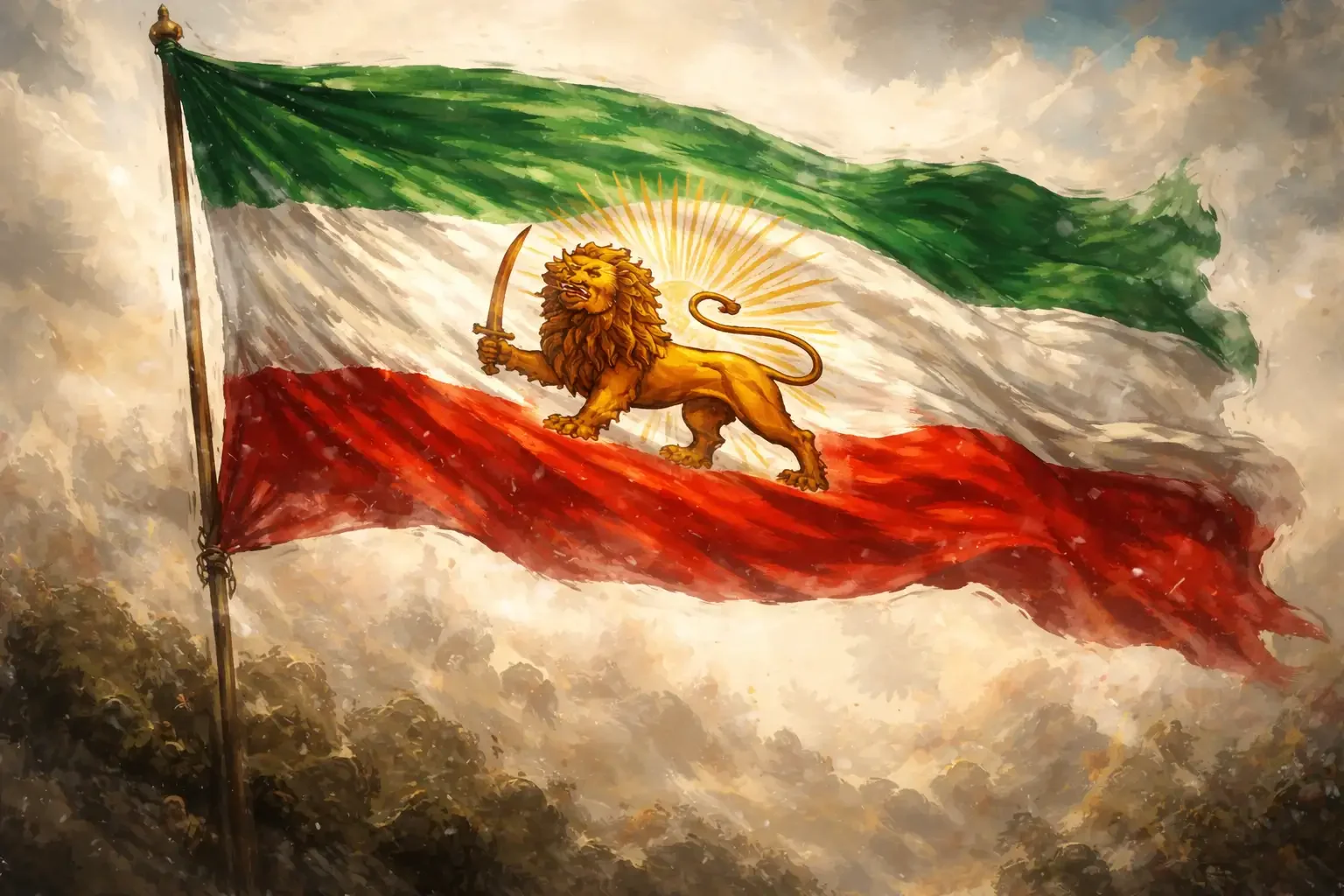
This change in perception of the Shah has no where become more apparent than in the waving of the former monarchist flag with its characteristic Lion and Sun which has now become a rallying symbol of the Iranian opposition. While it is the case that some republicans have preferred an emblemless flag to represent the cause, since the 2010s onward, the Lion and Sun has been both modified and widely adopted by those who oppose the Islamist regime. The use of the Lion with his sword drawn against a rising Sun has come to represent a new dawn of hope for many Iranians, as the official Islamic Nishan Rasmi-emblazened version is torn down from embassies, and the opposition’s one raised in its place.
From a Mazzinian perspective, this Iranian democratic revolution has all the hallmarks of what Mazzini himself articulated as his type of revolution. Among the many slogans being chanted in the streets, "Neither Gaza nor Lebanon, My Life for Iran" has emerged across many anti-government protests in Iran, in opposition to the regime's neglect of their future for the sake of Hamas and Hezbollah. But there is also an active courage being demonstrated that, in the realization that there is no possible future under this regime, the protesters in Iran are sacrificing their lives, not for themselves, but for their country and future generations. This, as tragic and desperate as it is, is in the spirit of the universal sense of duty and resolve that Mazzini articulated in his lifetime, and also is a strong impulse for us to act to support them.
Western Shame and Responsability
The fact of the West's role in Iran's fate is not controversial. Due to its geopolitical position, wealth, and its ancient history, Iran has been invaded and interfered with by many great powers over the 20th and 21st century. the most significant interference would come, however, in 1953. As democratically elected prime minister of Iran Mohammad Mosaddegh planned to nationalize Iran's oil industry due to British non-compliance with a state audit of its accounts, the CIA and MI6 conspired to overthrow the government and did the Shah Mohammad Reza Pahlavi full autocratic control. The coup d'état was perhaps the most significant catalyst in creating today's situation. The Shah, with his brutal intelligence agency, the SAVAK, repressed the Iranian people with mass surveillance, torture, and imprisonment. Despite the Shah's White Revolution reforms, which oversaw the Westernization of Persian society, and some softening of the repression in 1976–1977, it was not enough to prevent the overwhelming public resentment against the Shah.
It is tempting, like many do, to take a whip to our backs for what we have done in the past to the Iranian people. We have consistently intervened on the wrong side and propped up dictators and despots for our own advantage. But guilt is no source of comfort for anyone, and is just an excuse for not accepting the immense responsibility that we have inherited from our past interventions. While, out of our guilt, we have chosen to appease and coddle the present regime with our misguided diplomacy, we have not been there for the Iranian people in their struggle against clerical fascism.
Many people have noticed the comparatively empty streets in Western cities since these protests in Iran broke out. Despite almost two years of consistent dubiously dubbed “pro-Palestinian” protests, the lack of leftist activism, if not in support of the Iranian democratic revolution, then at least against their own government mowing them down in an internet blackout, has naturally drawn accusations of hypocrisy toward these activists who, by and large, have not said one single word.
But I think this charge is unfair, not least because it is perfectly expected. In fact, the hard-left’s silence over Iran’s revolution is not moral hypocrisy at all, but consistency. In wondering why they are not protesting against the ultimate theocratic and repressive regime (that they ironically characterize Israel as) that has one of the poorer records on women’s rights, the answer is simply because they support the regime, and thus oppose any action against it. Because it is anti-West, it is at least an ally for them, and even though it appears contradictory to us, it fits in nicely with their paradoxical tendency to support communism at home, but fascism abroad; relativism supports both revolution and reaction at the same time.
But we, on the other hand, also have to be consistent with our beliefs.
Whether we like it or not, we have a responsibility to the Iranian people. For all that we have done in the past in intervening on the wrong side, we have now an opportunity to correct that course and partially redeem ourselves by supporting the democratic revolution and helping the Iranian achieve the constitutional and secular society most of them would like to have. It is, while we have the means to do so, a moral imperative to help. Unfortunately, it looks like that window to support the revolution is quickly closing. As the US continues to dither on whether "strong action" is necessary to avoid another Iraq or Afghanistan, the Iranian regime is given more time to squash the hope out of the revolution.
Another Middle Eastern Democracy
It cannot be stressed enough what a blessing a democratic Iran would be for both the Middle East and the world. While the Iranian regime has been responsable for sponsoring the worst terror groups across the globe, a constitutional and free Iran would be a tremendous ally to the democratic world. And we would also would gain a great friend. We already know of the enormous contributions to humanity that Iranians have already made to humanity. From technology to science, philosophy and literature, the Persian character has already gifted us some of the greatest advances as a species. And this has continued with Iranians dwelling in exile, in spite of the regime in Tehran.
The fall of the Iranian regime would also have some very negative consequences for a number of states. While the usual suspects, China, Russia and North Korea, would lose a key ally, it is also true that its sworn enemies would ultimately lose out as well. The Saudi-Iran Cold War that has played out over the last two decades has been primarily driven by the religious divide because Sunni and Shia, but it has also been about competition between two regional powers, a reality that won't vanish if Iran becomes democratic.
What it would mean, however, is that the West would have another definitive option in the Middle East (and one which is more appealing) to turn to, rather than being reliant on Saudi Arabia or Israel. While Saudi Arabia has had a lot of cards to play in leveraging normalization with Israel over a path to statehood for Palestine, with a public in Iran much more sympathetic to Israel (though we should not exaggerate), it is possible that the proposed Iran-led Cyrus Accords could be signed quicker than Saudi could join the Abraham Accords. The Arab world would, once again, be on the back foot. Also, Turkey’s Neo-Ottoman ambitions would not fare well against a strong US-Israel-Iran alliance in the region.
But by far the greatest beneficiaries of a democratic Iran will be the Iranian people, and especially its women and youth. After decades of pariahdom and their futures being sacrificed to ideological causes abroad, the Iranian people would finally have the opportunity to join the rest of the world as equals and as friends. It will not be an easy road as we are seeing today, and the lack of defections from the army are a major barrier to seeing this turn into a genuine revolution. But it is an end that is tangible.
We are watching brave Iranians sacrificing their lives, not for their future, but for the future of their country and those who come after them, so that they can have these opportunities. And while we cannot do the same (and nor should we), we can certainly do what we can to support them in their struggle. We should all be giving our undying support in the name of the universal humanitarian cause for democracy that is now being embodied most vividly in Iran today.
Free Iran!