Sharp Power to Oust Maduro?
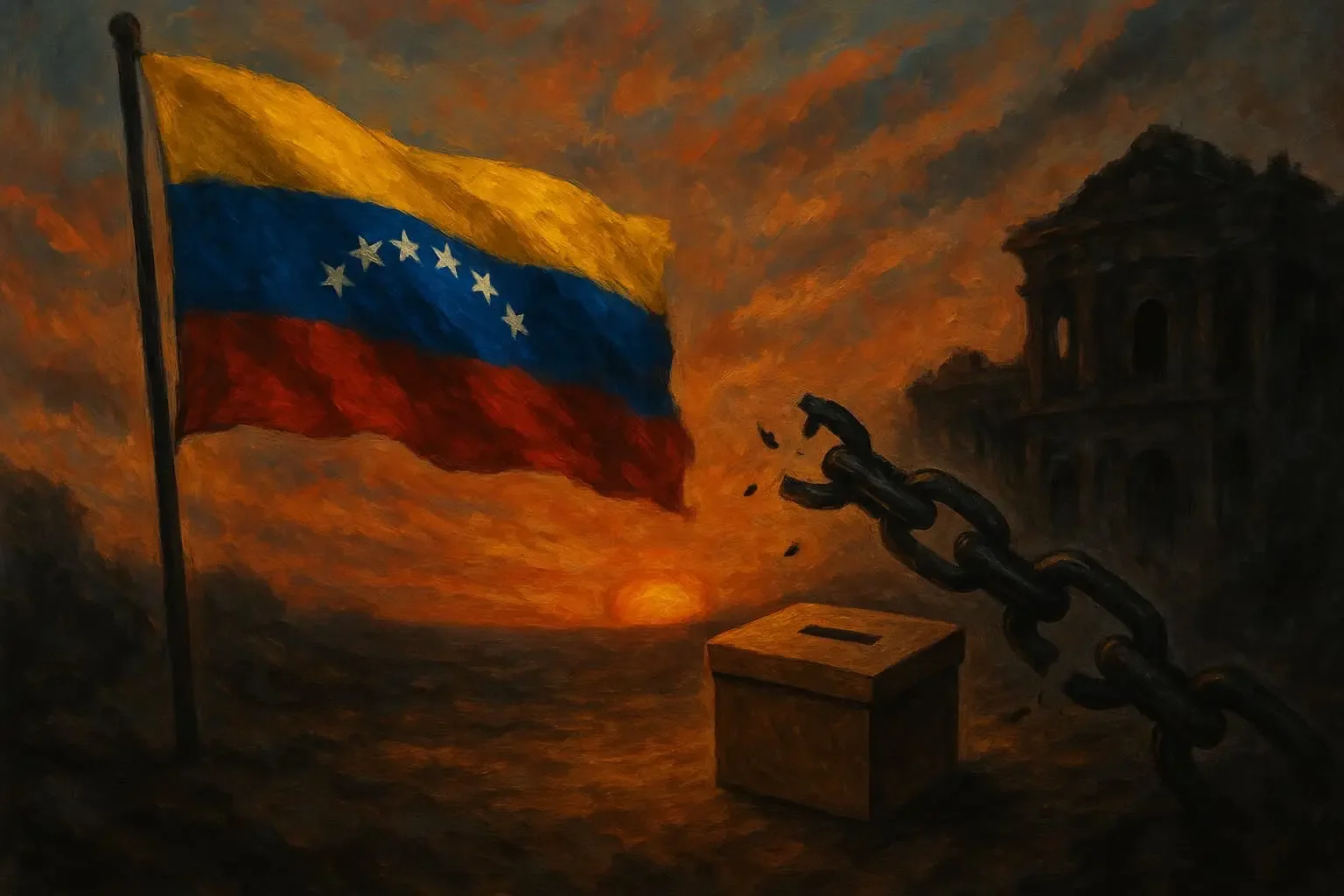
We've seen this pattern before many times with President Trump. First, he ramps up the pressure to the maximum; then conflict looks to break out any day; then he does a deal in the very last moment on his terms. It's a method he's already applied with North Korea, China, and Hamas to secure ends that benefit the United States while still making compromises to avoid overt action. And it looks like he's trying to do the same to oust Venezuelan dictator Nicolás Maduro.
A New Approach?
Given the failed attempts at regime change and nation-building in both Iraq and Afghanistan, a new approach for forwarding the cause of democracy might be appealing to democratic realists (like myself). Though remaining firmly committed to the principles of democracy as a combined moral and strategic necessity against the forces of totalitarianism, we shouldn't kid ourselves into believing that advancing those principles doesn't often require direct confrontation. Action and force against tyrants are often the only route to removing them for good. We are, as Christopher Hitchens once quipped, not "looking for a quiet life for liberalism."
But any good democratic realist should be optimistic at a new approach for regime change that doesn't involve mass violence. Force is justified only when a tyrant refuses to relinquish power peacefully; once they do, the justification for military action vanishes. And even then, the advocacy of any military action that will likely result in civilian casualties still carries an enormous responsibility, since no matter how tempting the principle, the human toll, facts on the ground, and the feasibility must be factored in; this, of course, is the art of ethics. And as we have sadly witnessed in Israel's war against Hamas, a just war in principle can become unjust in practice when civilian conditions become worse than dire.
In the Trump administration's latest escalation against the Maduro regime, it looks like Trump might be trying to avoid all of this. While his negotiation tactic has been used on foes and allies alike, the use of it to restore Venezuela's democracy and rid the world of another unneeded tyranny is an approach we ought to look at seriously.
Extreme Ironies
We usually save the threat of military force for use against the most aggressive, genocidal regimes. These are usually rogue states committed to oppressing and brutalizing their own people, as well as threatening their neighbors with the same. The 1991 international coalition against Ba'athist Iraq's annexation of Kuwait is generally cited as the best case for the use of force. But more recently, as Islamic State committed genocide against the Yazidis and viciously threatened the world with terror during the mid-2010s, few argued that diplomacy with the group would have gotten us anywhere.
The War in Afghanistan and the Second Gulf War, however, tested this theory to its maximum. While there was little arguing necessary to justify action against the Taliban and Saddam Hussein in principle, the extreme practical realities in both Afghan and Iraqi society made any attempt at nation-building nearly impossible. Ironically, while both were regarded as some of the worst totalitarian regimes in history, with arbitrary arrests, torture, state violence, and support for international terrorism, neither were great candidates for practical regime change. The dilemma, therefore, is that while the humanitarian situation might be the most desperate and intervention more justified, the more disastrous the consequences are likely to be, as totalitarian rule only makes a society less ready for the regime to be removed.
That being said, the reverse then is also true: the fact that the Venezuelan regime is not as extreme as Iraq or Afghanistan actually makes it a better candidate for regime change. And because it's more practical, that change is something we should be on the side of.
The Case for Removing Maduro
This in no way should diminish the suffering of the Venezuelan people, or remove the moral imperative of getting rid of Maduro. Despite presiding over a decade of repression, these last years have seen it intensify into an authoritarian regime with a democracy score even lower than Cuba’s on the Economist Democracy Index. From 2016 onwards, Venezuela has quickly deteriorated into one of the most repressive states in Latin America, with harsh press censorship and political violence.
Naturally, the background for most rapid autocratizations is rampant economic problems. Having invested most of its economy on its oil wealth, when prices came crashing down in 2015, it was sent into free fall. GDP crumpled, productive output went negative, and it quickly became one of the worst examples of hyperinflation, maxing out at 130,060% in 2018 (even per statistics from pro-regime sources). As a consequence, mass food shortages and poverty ensued, with 7–8 million Venezuelans fleeing the economic disaster.
Along with the economic crisis came the crackdown on democracy. Protests at the outcome of the unfair elections in 2017 (with the loyalist Supreme Court acting as a legislator) saw the first violent repression of the Maduro regime, killing over 120 people. Presidential elections held in the following years saw opposition candidates banned from running, exiled, or thrown in jail, and Venezuela officially joining the gutter ranks of other autocracies (as well as becoming their ally).
After the presidential elections in July 2024, where the opposition candidate Edmundo González was recognized internationally as having won the majority of the Venezuelan vote, Maduro continued to cling to power, claiming victory in clear defiance of the Venezuelan people. After stealing the election, Maduro turned up the state violence in the face of protesters, imprisoning over 2,000 and killing 25.
Today, the Venezuelan regime now has a significant criminal record, with the state security forces accused of crimes against humanity and thuggery. In a UN independent international fact-finding mission, the sexual violence against Venezuelan women and girls (ages 15–17) has been one of the more chilling features of the regime, with witnesses describing how "male guards demanded sexual relations in exchange for access to phone calls" as well as subjecting them to forced nudity; a state-sponsored embodiment of Latin America's epidemic misogyny.
Venezuela has also become a significant refuge for terror organizations in South America and abroad. From Colombian FARC and ELN to Hezbollah, international terrorism has found patronage from the Venezuelan regime. Moreover, Venezuela has threatened its neighbor Guyana with the annexation of Essequibo and been accused of employing Stalinist transnational repression tactics against political opponents.
The Venezuelan regime now has the characteristics of a regime that ought to be removed.
A Medium-Risk Move
One of the key differences that makes regime change in Venezuela more plausible than that of Iraq, Afghanistan, Libya, or Syria is the fact of its democratic history. Indeed, Venezuela's history of democracy has been one of the better ones in Latin America, with a long democratic tradition starting with the overthrow of dictator Marcos Pérez Jiménez in 1958. However, after hitting a turbulent time in the 1990s and then the election of Hugo Chávez in 1999, Venezuela began descending into autocracy.
Despite the obvious attack on Venezuela's institutions by the regime, Venezuela's democracy movement had not defaulted to regime change in order to remove it. In fact, despite the growing threats and repression, the Venezuelan opposition sought a constitutional resolution against Maduro, seeking to pressure him from the outside with international backing. After assuming an interim presidency in the face of the fraudulent 2019 elections, Juan Guaidó led the international opposition to the Maduro regime. But this strategy ultimately collapsed in 2021 as it was apparent Maduro wasn't going anywhere.
Since then, the democracy movement evolved, aiming for a united front by forming the Unitary Platform to contest the 2024 elections. That, and the push to motivate the Venezuelan people into a revolution against Maduro, led to the current democratic leader and long-time critic of both Chávez and Maduro, María Corina Machado, to emerge as the poster woman. After being barred from running in 2024, it was Edmundo González who ended up winning the elections on her behalf. Since the crackdown, however, and the Trump administration's harsher stance against Venezuela, the democracy movement has started seeing regime change as the only course.
Despite its failings and its drawbacks, it cannot be denied that Venezuela's democratic history and institutions represent a much more realistic prospect for regime change than that of other opportunities in the past. With a democratic system and culture already in place, the consolidation of a successful change in regime and return to Venezuelan democracy is perfectly possible, if the right commitments are made. While in the case of Iraq, efforts to transform a definitively non-democratic culture into a democratic one proved futile, in Venezuela, it is a matter of liberation of something that has already been there. In other word, this is about the restoration of democracy, rather than the imposition of it.
Another difference with Iraq and Libya is the lack of sectarian factions. While it is true that Venezuela is not free from groups that would vie for power if Maduro is removed, the risk of a vicious sectarian spiral is a lot lower than it was with Iraq. Overall, this makes Venezuela a relatively medium risk when it comes to regime change. In other words, this could just be the regime change without the headache of nation-building.
Then Why Not El Salvador, Huh?
Of course, the majority of the justification that I've used for removing Maduro could well be applied to Salvadoran President Nayib Bukele. During his crackdown on Salvadoran criminal gangs, Bukele has been emerging as the right-wing version of Maduro, governing the tiny Central American country with an iron fist. These hardline anti-crime policies have, in many cases, been hardly better than the widespread repression in Venezuela, with arbitrary detentions and appalling jail conditions for inmates.
Bukele has also developed his own enigmatic cult of personality, exported abroad as well as promoted at home, even calling himself the "world's coolest dictator." He has been the catalyst for the increasingly deteriorating state of El Salvador's democracy, with significant judicial interference and press freedom scores collapsing substantially since 2020. Perhaps most significant, however, has been Bukele's consistent brinkmanship toward his neighbor Honduras, with deliberate violations of its waters and territorial claims to Isla Conejo, mirroring Maduro's threats to annex Essequibo.
In short, the case for removing Bukele is also growing, and the principle is just as strong.
This is quite often the moment when supporters of regime change are accused of hypocrisy. Why would we support the US changing the regime in Caracas while knowing it won't in San Salvador? And the logic usually goes that, because the US won't get rid of Bukele, we shouldn't support them when they want to get rid of Maduro. However, the real world does not allow us to pick and choose which great powers will intervene and whether they will do it on the right side, and often it has to align with their interests. This doesn't mean that we should either give up our principles or apply them selectively. But it does mean if you really believe in them, you support democracy wherever you can. To argue otherwise really would be hypocrisy.
These conditions for removing Maduro or Bukele are particularly unique to both situations. While it is certainly true that Colombia under Gustavo Petro has been hostile to the United States and the West, he is and remains the democratically elected leader of Colombia and the current expression of the Colombian will. Colombia has also not threatened any of its neighbors (though its appeasement of the Venezuelan regime is despicable) nor has it become a dictatorship. This means that a similar-style intervention for regime change in Colombia would go against all principle. On the other hand, regimes that do meet this definition in Latin America remain today the Cuban and the Nicaraguan, both of which it would be justifiable to depose.
The Sharp Power Alternative: Benefits and Risks
This being said, trusting the United States, especially under its current administration, is a fickle business. The US's feet-dragging over Ukraine has only set us further away from any moral resolution to the conflict, doing nothing productive but heighten anxiety over the future. The US's pressure against Venezuela on the basis of it being a “narco-terrorist state” has also been undermined by Trump’s reversal of the Biden administration’s indictment of Honduran ex-president Juan Orlando, who oversaw (and helped) his country’s transformation into a narco-state. Such inconsistency does not fill one with confidence when it comes to principled action for Venezuela.
And it isn’t just policy that one should be wary of. The US management of Iraq and the disastrous withdrawal from Afghanistan mark serious concerns about the US’s competence as a moral and military power, despite it being the most powerful. In a scenario where the US intervened with a full-on invasion of Venezuela, the concern of its administration of helping the Venezuelans restore their democracy is a matter of serious scrutiny.
A full-on conflict to oust Maduro also poses other risks. In a recent Foreign Affairs article, senior analyst for the Andes at the International Crisis Group Phil Gunson highlighted the significant risks in removing Maduro, especially in the light of his potential replacement by the regime itself. Before Maduro even has a chance to be removed, he could be replaced by a more vicious dictatorship that would only worsen the conditions for the Venezuelan people. Or, despite not being on ethnic or religious lines, armed groups could turn the anarchy succeeding Maduro into a civil war that could also spill over into Colombia.
If the US does pursue an invasion, it must be committed, providing the democracy movement with the military support to prevent such a spiral. If it limits itself to purely airstrikes, Venezuela could run the risk of becoming another Libya, where NATO’s half-in, half-out approach produced a worse situation than under Gaddafi. It is imperative that, like Ukraine, the outcome of ousting Maduro really does come with a return to democracy. As with Ukraine, Machado could very well end up a Venezuelan Zelensky, whose democratic credentials (already questionable) might start slipping. It all would require serious oversight.
However, in highlighting these risks, it only strengthens the case for regime change of some sort. Negotiations and diplomacy only work with countries that play by the same rules and, as we have seen with Iran, internationally brokered deals only give tyrants more breathing room. But perhaps Trump’s sharp power approach might be able to balance both the need to avoid violence with the need to remove the regime, combining both threat of force that dictators respond to, without actually using it. The problem with this sharp power approach however is that it probably takes a Donald Trump to use it effectively. In fact, it might be a talent unique to him.
In using this threat of force as a psychological tool against the dictator, it could be that Trump brings about an end to Maduro’s rule that allows for some sort of power-sharing. In principle, it would introduce a gradualist agreement that would end in a peaceful transition back to democracy. Even with reports suggesting that Trump has rejected Maduro’s plea for amnesty, it is reasonable to think that it is all part of the sharp pressure he's applying.
A Personal Side
I have to confess, the Venezuelan cause in the movement for global democracy has not been one of my priorities. With the war in Ukraine more local to me and a preoccupation about China, the democracy movement in Venezuela has just not been as pressing. Indeed, until the rumors started of a possible US intervention, I considered it a dead end unless any other state power would be prepared to aid the Venezuelans.
However, as someone who lives in Spain, the Venezuelan cause has been more visible here than perhaps elsewhere. With both Madrid and Barcelona being significant destinations for Venezuelan refugees and exiles, their case is well-represented, and you are bound to meet one in either city. In fact, Spain has been one of the largest recipients of refugees, receiving 90% of all Venezuelan asylum applications submitted in the entire EU in 2024.
Also, with major left-wing politicians, from center-left to far-left alike, with dubious financial links and political connections to the regime in Caracas—particularly with the Delcygate scandal in 2020—, it is also a pressing issue on the Spanish political consciousness. Spain has been a major rallying point for the Venezuelan democracy movement, with various Venezuelan opposition leaders, such as Leopoldo López and Edmundo González, living here in exile. I even remember attending a rally held by ex-interim president Juan Guaidó in Madrid in 2020.
More recently, I asked a Venezuelan ex-colleague of mine about the situation in her country. As things were getting more violent after the presidential election back in July was stolen from González by the incumbent, she was concerned about what was going to happen with both her family and her country. A few months later, I asked her again about what life was like for her family still living there, and despite the shortages and long lines for food and fuel, life could be normal. “But,” she added, after I asked specifically about the freedom of the press, “you can’t write or publish anything about the regime.”
From all the Venezuelans I have met abroad, all share this universal ache for their country to be moved into the post-Maduro era. And despite not being as active as I should have been, the principle has always been present, just waiting for a possibility.
No to Triumphalism: A Solemn, Principled Undertaking
Advocating the removal of any regime, as I have said, bears a lot of responsibility. You must always balance well-reasoned principle with the way that conflict might evolve on the ground. For me, there is no doubt in my mind that removing Maduro is the right course of action, but I am of course concerned with how it is done. Indeed, if the US moves to install another dictator as it has done too many times in Latin America in the past, my support will be withdrawn.
Triumphalism is vulgar and force is not glamorous. Removing a dictator is not a celebratory blow against socialism or communism, but instead a solemn matter of principle. We are trying to bring dictators and their regimes to justice, not to win points in some game. And I hope that for the sake of the Venezuelan people, the United States remembers that and intervenes on the right side for a change: supporting the Venezuelan democratic revolution and guarding it against the forces of chavista reaction.