

Tár Review: Is Power Boring?
Spoiler Warning: This essay contains detailed discussion of key plot points and the ending of Tár. Readers who have not yet seen the film and wish to avoid spoilers may want to do so before continuing.
Lydia Tár reprimanding her “woke” student for his rejection of Bach’s music naturally made its rounds on my side of the internet. Superficially, there is always a savage enjoyment in watching a “countercultural” takedown, especially from someone in a position of authority, but that certainly shouldn’t be the only reason why one might want to watch a movie like Tár. Indeed, if that’s what you were looking for during the almost 3-hour duration, you would likely be disappointed.
For me, however, I was far more intrigued by Cate Blanchett’s delivery. Almost nothing seems to escape the sad trend of modern movies where plot is poor and dialogue is oversimplistic, but Blanchett’s performance in delivering Lydia’s articulate reproach was what really caught my attention. And I’m glad it did because the film—by and large—was worth the watch, and actually explored some deep philosophical ideas that I feel are worth writing about. Although, as I will explain, it didn’t quite explore them thoroughly enough.
A Gray, Unabashed World
One of the aspects of the film I really appreciated was that it treated its audience as adults. It did not try to talk down or infantilize us, but rather held us to a higher standard and challenged us to understand it, but in the context of classical music and in terms of the adult themes portrayed. Though the theme of classical music acted more as a wrapper for the plot than the subject, it was masterfully interwoven and dropped references that only the classical music community would understand. Even I, still a novice to the world, enjoyed the reference to Max Bruch early on in the film.
The film was not abashed about portraying its characters as genuinely morally gray either. While many films nowadays continue to paint characters as either black or white, or try to provide some justification for their immoral actions (the tragic villain’s backstory), Tár was comfortable with portraying powerful characters as they really would be: messy, complex and contradictory; it was completely devoid of childishness. This realism made for honest watching and a painfully clear window into a genuinely adult world.
This being said, however, at the end of the film I found myself feeling unsatisfied. It was not due either to the acting, the plot or the production, but I couldn’t make up my mind as to what the film was actually about. I couldn’t understand what it was trying to say. Now, the obvious response is that it wasn’t trying to say anything but in fact show something: how power, in personal relationships and professional careers, is executed, illuminating the extents of human nature and justification for certain action under extreme moral conditions. However, for me, I noticed that, other than power, there was another, profoundly philosophical idea that could have been explored, that might have made the film stand out.
The Human Metronome
What Tár could have explored—rather than being just another power drama—was the almost dialectical interplay of the philosophical nature of the self and of identity. While this might seem a bizarre interpretation, the initial ideas of this were set up right at the beginning of the movie. Indeed, I actually think this interpretation removes the superficiality of the classical music wrapper and gives it a symbolic value.
The opening scene, where Adam Gopnik is interviewing Lydia on her upcoming book and performance of Mahler’s 5th symphony, the concept of identity is first alluded to, though not necessarily in the conventional way we are used to thinking about it. Gopnik asks Lydia about translation: the way a conductor interprets and transmits a composer’s music in performance:
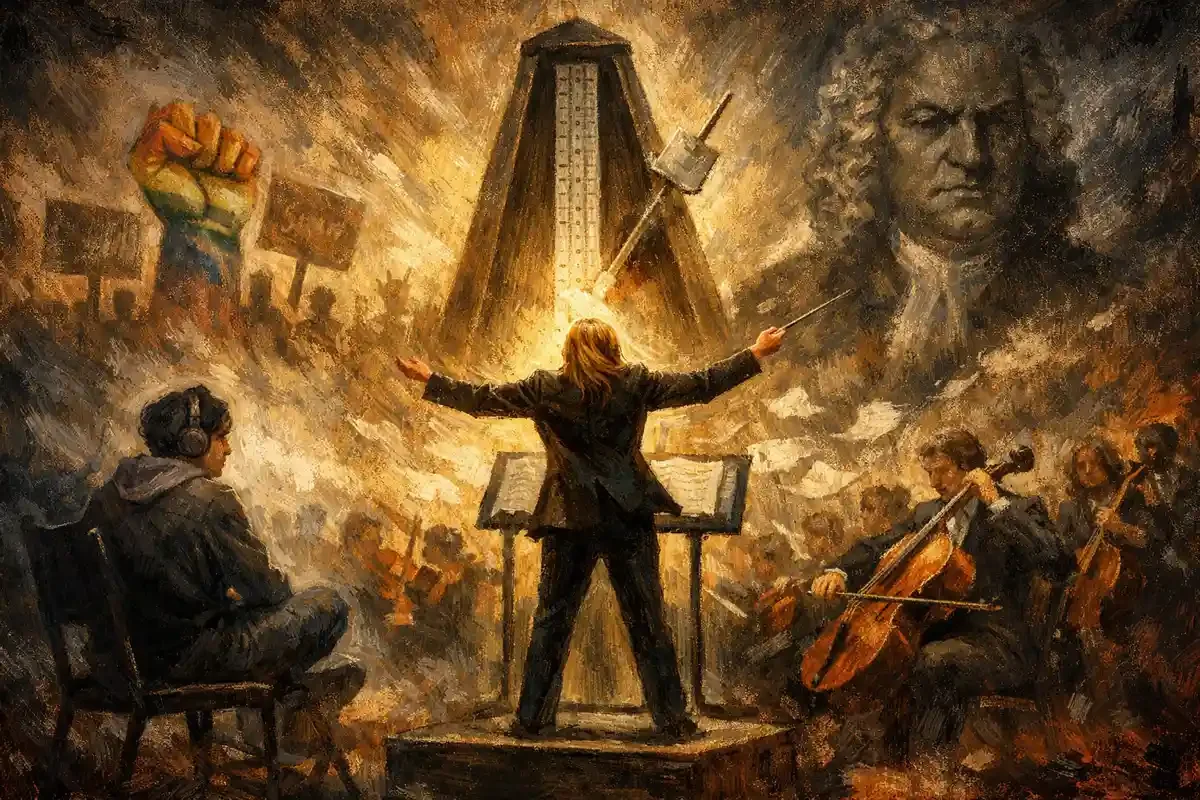
“Lydia, can we talk a little bit about translation. Because I think there are still people out there who think about the conductor as a kind of human metronome.”
This term, “human metronome” conceives of the conductor as reducing them to a single mechanical role. In other words, it conceives them often as having to reduce their humanity and being merely a robotic timekeeper that, though steering the orchestra, just channels the music of the composer while depriving themselves of any individuality. While Lydia’s expected response was to deny this characterization, she actually agrees with it: “well, actually that’s partly true,” and indeed, this surprises Gopnik who insists that there “must be a lot more to it than that.”
The reason why this small part of the interaction stuck out for me is because Lydia’s response seems to challenge a mainstream and politically correct view of how we look at identity and individuality today. In our modern perspective, the idea of reducing one’s individuality for any reason is looked on as problematic. This is, after all, an era where pride in our identity is encouraged (for whatever form it takes: racial, sexual or cultural) and that if we suppress that in any way, it is looked on as something authoritarian.
For Lydia, however, the idea of the human metronome is an accurate depiction of what the conductor does: “keeping time is no small thing” and that “time is the essential part of interpretation.” What I think she’s really trying to say here is not just that a conductor has an essential role when it comes to directing an orchestra, but actually that the individual intuition of the conductor is what actually drives the interpretation of the music into something that is entirely new. Indeed, her qualification of this, that the only real discovery for her “is in rehearsal,” plays into this idea that the conductor’s role is not actually the suppression of one's individuality (falsely equated with identity), but is instead an active form of discovery.
Finally, Lydia explains this with her perspective of the Hebrew concept of kavanah, “intention”:
“It’s the Hebrew word for intention to detail or intent. What are the composer’s priorities and what are yours, and how do they complement one another.”
What Lydia is really indicating here is the conductor’s need for humility in order to fully combine the self with a meaningful interpretation of the music.
Juxtaposing Self vs. Identity
Up to this point, however, this contrast between self and identity in Tár is not quite set up properly, but it is ultimately juxtaposed in her reprimand toward her student in the well-known clip of the movie.
Her student, Max, claims that he’s not “into Bach” due to his identity as a “BIPOC, pangender person… Bach’s misogynistic life” makes it impossible for him to take his music seriously. Of course, this answer doesn’t impress Lydia. In fact, she goes on to take the point that Max makes—that what could “a bunch of straight Austro-German church going white guys” possibly exalt in us (in classical music) that is relevant to us today—and responds that as a “U-Haul lesbian,” she’s unsure about Beethoven. But then she says that, despite this, she “faces him and finds herself nose to nose with his magnitude and inevitability.”
What Lydia is expressing here is partly what she was talking about in her interview. That, in order to confront and discover truths expressed in classical music, as a conductor you must put your identity to one side in order to listen to what they have to say; she is, in effect, saying that one must face the musical expression of a composer with humility, rather than imposing your own pre-defined identity onto how you receive the music. She then plays Bach to Max, trying to illustrate how the composer himself faced uncertainty in his own music.
But perhaps the most important way she sums this up is when she says:
“My prayer for you is that you will be spared the embarrassment of standing on the podium with a 4’33” trying to sell a car without an engine. Because now, my friends, now is the time to conduct music that actually requires something of you. You know, music that everybody knows but will hear differently when you interpret it for them.”
This really underlines the importance of her philosophy, and why the removal of identity for a true interpretation of music does not mean the removal of individuality, but actually requires the conductor to grow as an individual, counter to what they know about themselves. In other words, this thing that is required of them is actually the extremely difficult task of facing those things that you do not understand and that do not conform to your way of thinking, and looking at them with utter humility.
The juxtaposition between Lydia and Max is perhaps extremely poignant. The typical stereotype of university students today is their arrogant discard for anything that does not conform to their identity. The whole concept of “safe spaces” is to ensure that an individual never needs to challenge their identity or undergo the pain that accompanies it. Lydia rails against this and is arguing that it is necessary to undergo this pain (through humility) in order for the audience to hear music in a truly new way. The irony is that in order to fully become a truly creative conductor, one must abandon their identity.
Lydia rounds this off, as Max storms out after she humiliates him, with a single dramatic phrase:
“You want to dance the mask you must service the composer you got to sublimate yourself your ego and yes your identity you must in fact stand in front of the public and God and obliterate yourself.”
The reason why I find this aspect of the film so interesting is because it echoes the philosophy laid out in Jiddu Krishnamurti and Simone Weil, who both emphasized this type of sublimation of identity (though neither described it as such) in order for the human being to be both free and live a moral life. For Weil in particular, this release of identity and the ability to be attentive to others was the basis of her philosophy of love.
A Weird Lurch
Unfortunately, however, the film seemed to ignore exploring any of this that it had set up within the first hour. Indeed, I failed to feel any connection with the themes explored in the first act and Lydia's slow descent from respectable and celebrated classical music icon into scandal. While there is nothing necessarily wrong with the course it chose in the end, the reason for my dissatisfaction toward the end was just my response to how lackadaisically it was explored.
Power dramas have always been popular, but as we have become more cynical in this current era, watching the darker sides of our personalities played out on television feeds a need that we cannot ethically fulfill ourselves. From Game of Thrones to The Boys, hyper-realistic dramas are still the rage, and when done well they are very exciting. Indeed, perhaps the best piece of entertainment in the last few years has been HBO’s neo-Shakespearean Succession, whose dramatization, from script to acting, I consider nearly faultless.
However, for Tár, I don’t think this weird lurch toward a power drama worked very well. While it was interesting to watch Lydia abuse her position and force what she wanted with her partner and daughter, the fact is that it made the film quite boring; I was waiting for something to happen, for some big reveal, but in the end it turned out to be a bit anticlimactic. Unfortunately, I’m forced to wonder if this shift to power was actually due to the theme’s popularity rather than actually wanting to explore anything new.
A Solid Seven Then
I’m aware that there are better reviews than mine that can go into the intricacies of the plot and the film’s failings, but I do think these philosophical themes are worth emphasizing, especially nowadays. In a world where most people believe they already know who they are and that there is no real room for self-improvement, it would have been novel to watch a drama where this could have been further explored, however symbolically through classical music. In the end, Tár for me ranks among almost all movies and TV shows today, as a solid seven out of ten.