
The Kicked Can Finally Runs Out of Road
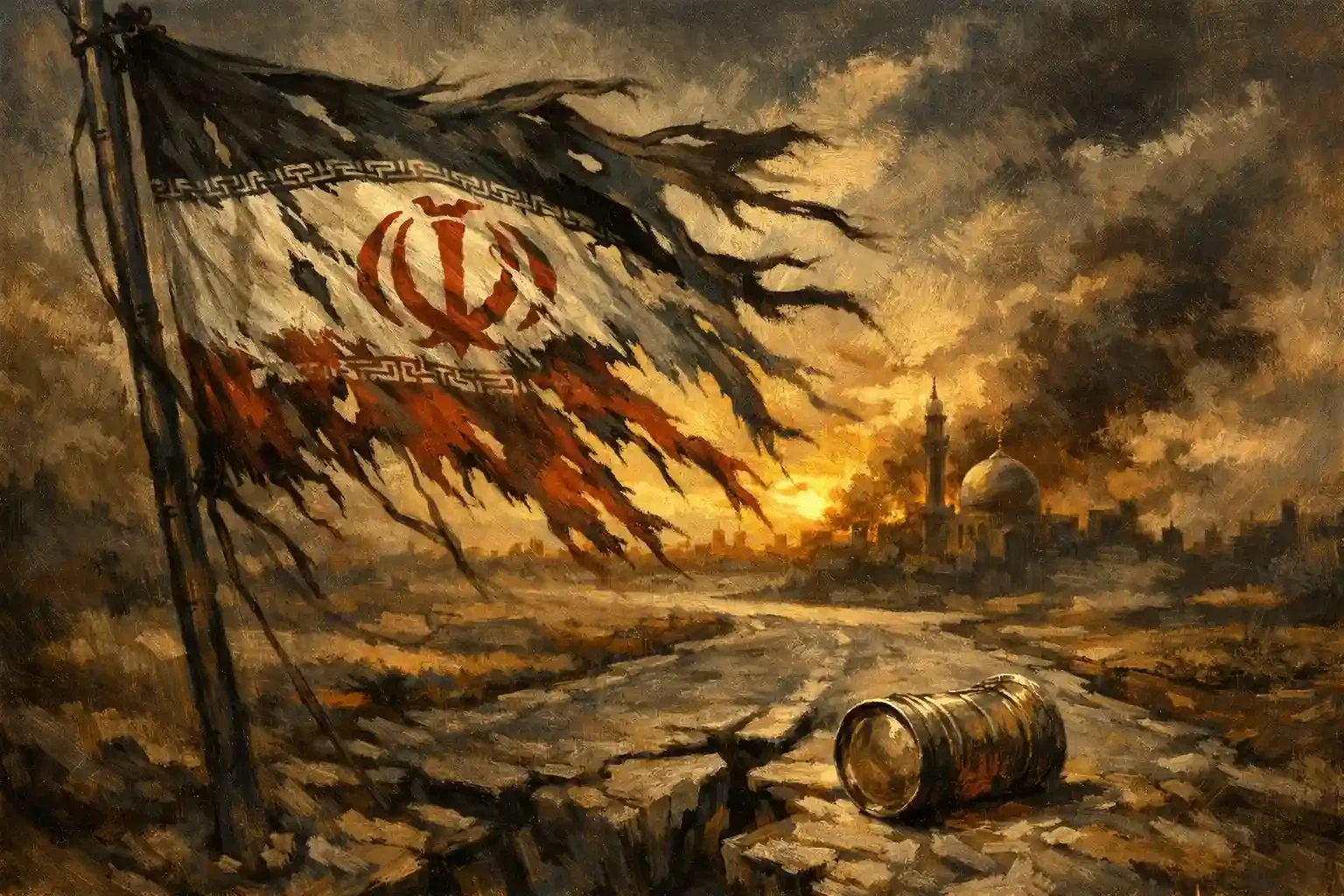
After nearly fifty years of violent dictatorship and regional brinkmanship, could be it that the clerical fascist regime is seeing its last days?
Ever since the Twelve-Day War broke out between Israel and Iran last year, the case for regime change in Tehran has been at its strongest ever. While the humanitarian case has been one of the most significant in history, the practicalities of removing the clerical-fascist regime and replacing it with a democracy have always been fraught with perils. The resultant disaster of the US-led intervention in neighboring Iraq has always shrouded any direct action against Iran with a thick layer of doubt and has probably been the chief reason for seeking other, more diplomatic solutions to dealing with the regime.
I remember talking to an Iranian student at university in London. While many years my senior, he was taking the same Sanskrit classes, and toward the end of the term we had a moment to talk. I asked him directly what he thought about a US-led intervention in removing the regime (this being back in 2017), and he said that, before witnessing the violent destruction following the Iraq War, he and other Iranians he knew would have been in favor of it. However, given the vortex of horror following the intervention in Iraq, his view was now far more pessimistic. In fact, this also reflected the sentiment of a North Korean defector whom I met the previous year and asked the same question. He also would have been supportive of US-led regime change if it weren’t for the fact that the North had acquired nuclear weapons.
This last point of North Korea acquiring nuclear weapons is highly relevant for the case for regime change in Iran. While the conventional diplomatic tactics and sanctions have done the regime some economic damage, there is little doubt—given the behavior of the regime, especially in recent years—that this has been a failed strategy, as well as an astoundingly reckless one. The clerical regime, in spite of the economic pressure, has merely passed it onto its own citizens, while it has continued to pursue regional brinkmanship in the form of sponsoring terrorist proxies and obtaining nuclear blackmail against its Arab neighbors. The “breathing room” that these on-again, off-again sanctions have provided the regime has only increased the likelihood of a conflict by emboldening it to pursue a more gradualist strategy. Its loose leadership of the Axis of Resistance has been slowly tightening a noose around Israel, from Hezbollah in Lebanon, to Hamas in Gaza, to the Houthis in Yemen. This salami-slicing threat was only effectively dealt with because Hamas decided to jump the gun on October 7. If the nightmare scenario of North Korea achieving nuclear weapons is anything to go by, sometimes the supposed “sensible” and “diplomatic” approach can be just as dangerous as using force.
The last straw for the moral imperative to intervene against the regime came, of course, with its decision to massacre 30,000 people for protesting against the economic and human conditions it was remorselessly imposing. Under the cover of an internet blackout (how’s that for denying access to journalists?), the regime’s crackdown will perhaps go down as one of the most dystopian in history. But it has also become the real beginning of the modern Iranian democracy movement and revolution. As I argued in my essay on the Iran protests in January, the growing action against the regime has crescendoed into one of its most significant internal threats since its establishment; and in the Iranian diaspora, the desire to see the fall of this Islamist and theocratic Iran is at its most popular. However, the crackdown proved another uncomfortable truth for those of us in the West: the Iranians can’t do it alone.
Quite often, in our reluctance to take decisive action against evil and tyrannical regimes, we let the privilege of a clear conscience override the humanitarian imperative to advocate for action. While many have accused neoconservatives and liberal interventionists of cloaking their true interests in the language of humanitarianism, I would accuse those who argue against regime changes of engaging in the same thing. Concerns for the humanitarian impact of wars, though vital, can quickly turn into an excuse for not dealing with the complex moral questions that are presented when it comes to achieving liberty and democracy. It is as if Europeans and Americans in history didn’t have to also engage in violent overthrows to attain what we have inherited and enjoy today. Too often we let the letter of international law excuse us from implementing its spirit, and we allow tyrannical regimes to weaponize it against us.
In some cases, we also adopt the “set yourself free” argument, which was best illustrated on a 2012 BBC Question Time episode in which British historian David Starkey argued for this very same position. But, especially in the light of the brutal regime’s response to the protesters in Iran, this line of argument can be even more callous than arguing for military intervention. In possession of the means to help a people achieve these humanitarian aims, we would rather sit and watch while they try and do it themselves and, unfortunately in many cases, fail. We only have to look at Tunisia, Libya, and Myanmar to know what happens when we take this approach. From a Mazzinian perspective, our moral inconsistency when it comes to wishful ends and avoidance of action is a betrayal of our duties toward our democratic allies. We are obligated to help to reduce the suffering or face the consequences of our inaction. It is also important for not pushing others to do the dirty work without any guarantee of our support, which has been reportedly currently going on with the Kurds again.
There is no doubt that the death of Supreme Leader Khamenei is a cause for celebration, not only for Iranians who have borne the brunt of his repression for almost five decades, but also the rest of the world. His assassination is much like that of Osama bin Laden in 2011 and Abu Bakr al-Baghdadi in 2019. For too long, he was allowed to be one of the most dangerous dictators, and his repeated offenses against international law and the people he proclaimed to be a “guardian for” can now never be repeated. While it would have been better for him to stand trial to answer to his own people (one of the few merits of the Iraq War), he won’t be missed. However, despite this, it is important to be cautious regarding the US approach when it comes to the war. While I’m sure many would argue that oil contracts in exchange for democracy would be a fair trade-off when it comes to removing the regime, Washington has yet to uphold that side of the bargain in Venezuela, despite a little progress in regard to political prisoners. The push must continue for a democratic Iran, and any other option is unacceptable.
So, where Washington’s logic falters is not in the recklessness of its going to war or in its moral recognition of its necessity, but rather in the extent. As with the Twelve-Day War where the president was effectively mugged by reality, his restraint in the ongoing intervention might prove to be insufficient and we’ll need to intervene properly anyway.
While Donald Trump thinks he’s discovered a new method for regime change, it has yet to be revealed how effective or applicable it might be. The logic that, if you can take out the main troublemaker, replace them with a more pliable pragmatist, make some economic deals in the US’s interests, hopefully the euphoria of seeing a dictator fall will be enough, and that democracy will come in time. There are a number of reasons why this approach might be attractive to Mr. Trump since, faced with a base that is overwhelmingly against America getting involved in “another endless foreign war,” he can still deal with geopolitical reality, advance US interests, and preserve his political position all at the same time. The problem is, as stated above, his other test case in Venezuela hasn’t seen much progress on the matter of democracy either, and hunting for a “Delcy” in Iran to replace Khamenei is likely to be impossible.
Also, from a strategic point of view, the danger of not assuming more responsibility over the outcome in Iran will likely come back to bite the US, as it has before. While tactically this could be a good move to slowly watch the regime collapse in on itself from the outside after pushing it to the brink, allowing it to persist, rebuild, and start again would be just as reckless as the concurrent push for resuming diplomatic normalcy, and prove to be just as callous as the “set yourselves free” argument. The resilience of dictatorships is in the fact they don’t care about what they have to do to ensure the survival of the regime. The full regime-change route, where the Iranian democracy movement could consolidate itself with the guarantees of US security, therefore, is the only wise and definitive way ahead.
In an article for The National Interest, Charbel Antoun argued that the US should avoid two scenarios that would ultimately create greater problems. The first is that the US should avoid the partitioning of Iran from the outside and that any constitutional reform (i.e., a unitary or federal state) ought to be the internal decision of post-Khamenei Iran and ratified democratically by the population. A “break-up strategy,” he argues, would only confirm for many Iranians the regime’s propaganda that “the West seeks to dismember Iran.” It would also allow for countries like Turkey to pressure Iranian Kurds as well as Pakistan and the Arab states to influence militias.
The second red line Washington ought to follow is to avoid installing another despot to replace the Islamist regime. From a democratic perspective, this is an obvious point to follow since the result of the Iranian democratic revolution ought to be democracy and an end to any dictatorship. However, from the perspective of the White House, the temptation is there as an easy solution and for making a compliant Iran. Morally, installing another dictatorship would be a disaster, but also strategically it would be no better than the kicking-the-can-down-the-road approach. There is some hope, however, that this won’t be necessary, given the readiness of Crown Prince Reza Pahlavi to step up as a unifier; however, it is also true that the democracy movement has still to put up a true united front themselves to present themselves as a viable alternative. That being said, only a democratic Iran can end the violence of its internal divisions and make it a genuinely long-term strategic partner for the West and the region.
From the Israeli perspective, there is no question that a democratic Iran would be in Israel’s interests, but it is also deeper than that. There is, for the most part, a genuine humanitarian and fraternal feeling from the Israelis toward the Iranians, and there is some evidence to suggest this is also reciprocal. For Netanyahu, despite his terrible failings over the war in Gaza, it could be a great moment for him to rebuild Israel’s reputation in the region with its Arab neighbors and, possibly, gain a friend in Tehran. But we need to hope that the US president will also see the strategic wisdom in the democratic approach, even if he’s uninterested in the moral question.
The most striking phenomenon, besides the surprising weakness of Iran’s defenses against the strikes, has been the complete irrelevance of Europe. Europe, despite condemning the crackdown on protesters, has yet to play any significant role in helping the Iranian people: most have remained stiff and elusive. While it might benefit individual politicians in precarious positions to condemn the US and Israel’s preemptive action, I know we in the democracy movement, and I’m sure many Iranians, will remember Europe’s inaction when democracy finally wins out.
Trump running his mouth off at Netanyahu is probably justified, but the US president is really at fault for the disastrous intervention against the Iranian regime.