

Desperate Center-Left Looking to Cynical Sánchez
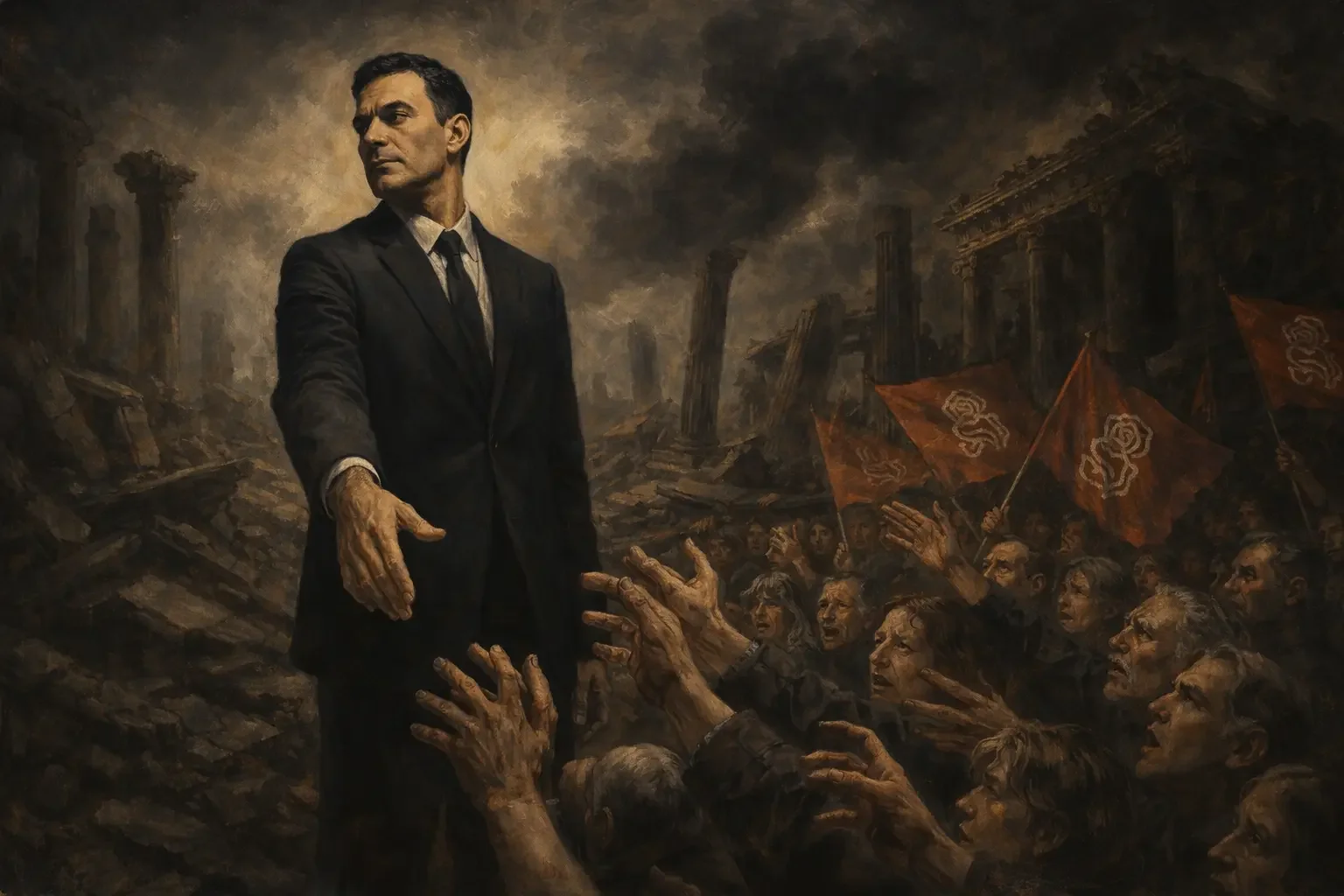
A center-left that is scared and desperate will look to ever more demagogic alternatives to save them.
Sr. Sánchez appears to have been very busy in the international sphere lately. While domestically he and his party have been losing one election after another in Extremadura, Aragón, and now likely in Andalucía, over the last few months he has appeared in the Wall Street Journal, the New York Times, and even on the British podcast The Rest Is Politics. Seen as the last bastion against the populist storm that is continuing to wear away support for social democracy across the continent—and apparently leading the global opposition to Trump, despite no one really knowing who he is—it's becoming clear that, faced with political decline, the center-left is increasingly looking to Sánchez as some sort of savior.
Traditional center-left parties have been gradually collapsing across Europe. From the German SDP’s historic loss of the industrial Rhineland or the “dramatic slump” of the Social Democrats in Denmark, the failure of the center-left has, despite being less of a bang and more of a whimper, been stark. Even in countries where a center-left party has maintained a strong institutional presence—such as the UK’s Labour Party—support has declined in favor of alternatives in the form of right-wing and populist parties. Perceptions of center-left betrayal among traditional bases and their inability to respond to the real social problems that have become concerns for their voters, these parties are facing political redundancy.
Sterile centrism—for all its merits of stability during good times—has become corrupt, unexciting and incompetent.
When an old order declines and faces a crisis that it can’t respond to, the rational path is to examine what you got wrong and how (if you can) respond to it. Unfortunately, the center-left in much of Europe, for all its pretense, has never been that rational. Even when presented with landmark opportunities to redeem themselves—as in Germany or in the UK—there has been no real progress on the issues that really matter to voters, simply because there is such a divergence between the worldview of their base and their own. Immigration, loss of community, national cohesion, have all been better responded to (at least politically) by other parties, which is why voters will not see reason to give these parties another opportunity in the future. Instead, the center-left has acted out of its desperation to cling onto relevance, and has been increasingly turning to more extreme alternatives to do so. They employ increasingly more demagogic rhetoric in order to whip up cheap support through fear, and use more Machiavellian tactics to fiddle the political system.
Thus, Pedro Sánchez’s recent little international press tour has been a help-me-help-you situation. While Sánchez has needed to utilize the international arena to distract voters from his own sleazy corruption scandals, the center-left have needed him out of a desperate need to point to some success. While the center-right have been increasingly seeing Sánchez as a thorn in their left side (as Orbán being the thorn in their right), the center-left have been congratulating Sánchez on his “leading” role against Trump’s US. While most European leaders have been indecisive over the White House, coming out firmly as an oppositional voice has been another strategic masterstroke for the Spanish premier, and has made the rest of Europe look foolish for not being more forceful.
Sánchez has also seen glowing reviews for his apparent dedication to left-wing values and progressive policies. While in reality, his hand has been forced by his Faustian alliance with the far-left, far-right and separatist parties in his coalition, the high-tax, high-spend budget has allowed him to push for old school left-wing policies in the economic sphere which (on paper), seem as if he’s setting an example for what a principled left-wing party ought to look like in the modern day.
But in this regard, Sánchez has more of Carl Schmitt than of Felipe González about him—which is ironically why he is being seen as a savior for the center-left. For while right-wing populists continue to eat away at their votes, the center-left has more openly been legitimizing even authoritarian tactics to keep the right out of power permanently. This state of exception has been a firm—if informal—tactic of the Sánchez government since his failure to win the 2023 election. Being “flexible” over who participates in your coalition and willing to undermine Spanish democracy for the sake of locking out the right for as long as possible. Trading on the center-left’s brand of perceived reasonability, he has been able to justify actions that, if performed by a right-wing parties, would be highly questionable. Indeed, you only look at that uneven criticism between Sánchez and Orbán to notice that.
However, seeing Sánchez as a savior will be yet another nail in the center-left’s coffin. In its desperation to maintain its own relevancy, it will ultimately prove itself willing to abandoned all and any principles of social democracy to preserve its ideological ends. And this will ultimately be the center-left’s folly when it comes to countering the hard and far-right, and perhaps rightly, it will eventually disappear from the political scene altogether. This will allow for another movement to emerge that defends the same values but within a more political relevant context. As the political worlds in Europe and the US move away from the clashes of capital and labor, the truly needed social policies can be formulated to tackle issues, rather than being lagged behind by old paradigm-thinking. This will likely come from a new left-wing approach to the question of belonging. While national unity and internationalism are being pitted against one another as values, a future movement that can fill the gap left by the fading center-left will be able to synthesize the two into a coherent response to isolationism and chauvinism.

Daron Acemoglu’s new book “What Happened to Liberal Democracy?” hits on the right mistakes made by liberals, but misses the point of what the future of politics needs to be.