

Leaving North Korea Tragically Alone
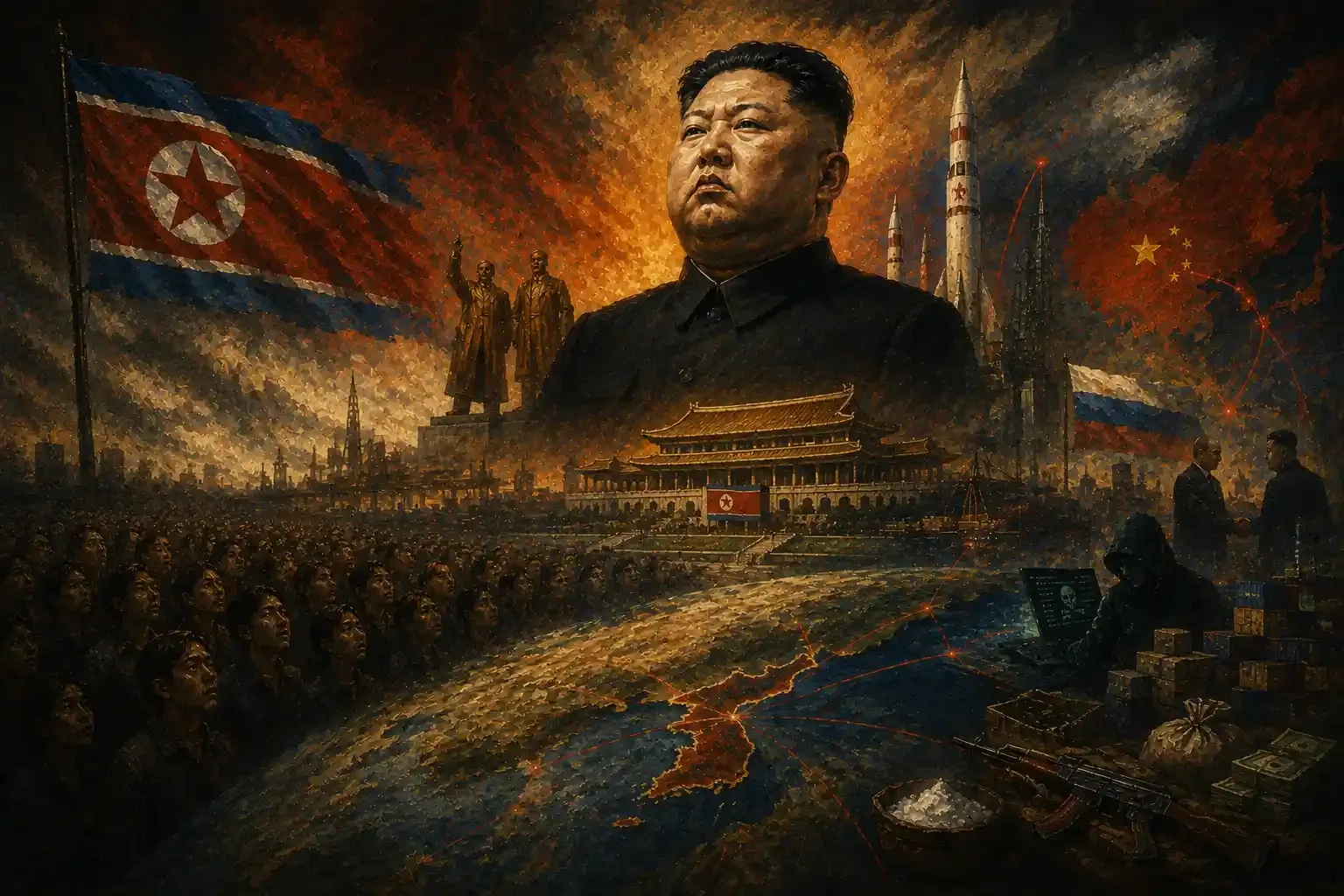
The tragic reality of a nuclear North Korea means its people’s liberation has been postponed indefinitely.
At a university talk in London given by two North Korean defectors, I remember asking one of them whether he thought that the US ought to intervene militarily to overthrow the Kim regime. It wasn’t a question that he’d been asked before, but he answered it with an honesty that, admirably, pleased no one. “Yes,” he said, “but now the regime has nuclear weapons, it’s not possible.”
The tragic weight of this response, though particularly applicable to the North Korean case, is also reflective, I think, of how many people under tyrannical dictatorships actually feel. That, given the desperation of life existing under these types of regimes, its endurance really is worse than a war for their removal. But the candor of this defector (whose name for the life of me I can neither remember nor find) that the one thing that would be worse would be a nuclear holocaust, is what really makes North Korea’s nuclear weapon status so terribly tragic. Especially since, given the right action beforehand, it could have been avoided.
The Iran War has renewed talk over North Korea and its nuclear status. The intervention of the US and Israel to prevent Iran from becoming a nuclear weapons state might seem to those unconvinced by preemptive measures to be an overreaction given the facts, but if the North Korean nuclear reality is anything to go on, any action to eliminate the possibility of such a regime getting its hands on the ultimate blackmail material is to be considered—regardless of diplomatic or commercial consequences. And indeed, a nuclear North Korea has now transformed every approach to the security of the peninsula (and the world) that we once pursued.
The liberal international order has a lot to answer for over North Korea’s nuclear status. For that matter, they also have a lot to answer for over Ba’athist Iraq and Iran, but the fact that a hostile totalitarian regime like the one in Pyongyang has managed to acquire and develop an increasingly capable nuclear arsenal is a stain on the constantly parroted effectiveness of diplomatic methods. The insistence of trying to bring North Korea to the negotiating table to prevent nuclearization, instead of taking more overt action when the opportunities presented themselves, has not only made the world more unsafe, but has desperately failed the North Korean people by sealing off their liberation indefinitely. That responsibility lies in the hands of the now collapsing international order.
However, I’m not so naive as to believe North Korea wasn’t already a major threat before it got nukes. The threat perpetually concentrated on Seoul with conventional weapons alone would have had consequences that were equally devastating. This, naturally, was the reason why Bill Clinton opted not to strike the Yongbyon complex in 1994 after North Korea pushed on with its “campaign to harvest weapons-grade plutonium”, and it is a valid reason, given the serious concerns for South Korean civilians. But the alternate reality—the one in which we live—has meant that North Korea has now become an even more potent threat and effectively an egg we cannot unscramble. Catastrophe in one form or another may always have been unavoidable, but the difference now is that our options have narrowed considerably as we resign ourselves to dancing to Pyongyang’s tune.
The North Korean persistence on obtaining nuclear weapons lays out the plain case for why global policing is necessary. No sanction, threat, or commendation was ever going to dissuade the North Korean regime from obtaining nuclear weapons. These measures are always punitive on the general population anyway, and rarely affect the regime, who usually learn to adapt. The stark fact is that the only way the regime would ever truly denuclearize would be through its removal by force. This always ought to be a lesson we should learn from not acting sooner to prevent these nightmare scenarios and that presumption of innocence for these regimes will cause more damage than otherwise.
The reality now is far more delicate, as not only has North Korea insured itself against a Gaddafi-style fate, it has also been able to leverage its new position as a nuclear state to expand its international relations with other great powers. Apart from significantly increasing trade with China, Kim has developed comprehensive agreements with Russia, including a mutual defense pact as well as sending North Korean troops to fight in Ukraine. He has shown himself to be savvy in international affairs by playing the great powers off one another in order to ultimately come out as a beneficiary of seeing both Putin and Xi scramble for him. Indeed, Ukraine has allowed the North Korean army to gain valuable experience on the ground, and has largely improved as deployment has continued. On the back of this, the North Korean regime has also focused on its international criminal activities, becoming a significant cyber threat as well as a key player in other illicit markets such as drugs, weapons, and human trafficking. And all of this is now protected by a nuclear shield that is unpredictably volatile.
Dealing with the North Korean regime has now become one in which the bombastic military-first approach has to take a backseat. While with Iran the window of opportunity to remove the regime through military action has remained open, for North Korea it has been firmly closed. Preemptive strikes are out of the question and any attempt to remove the regime by force will not be possible without an unthinkable humanitarian catastrophe. If the European frustration of not being able to intervene properly in the Ukraine war is to be a guide, the threat of nuclear annihilation is one that just needs to be accepted for the long-term, and while negative for the region and the world, it is even more tragic for the North Korean people who continue to suffer the regime’s brutality.
From my perspective, a change in approach in accepting North Korea’s nuclear status doesn’t necessarily mean a change from offensiveness to defensiveness. It matters instead how we go about the offensiveness, and much of that can be derived from the regime’s growing openness, increasing dependence on great powers, and future structural problems. While the Russian-North Korean alliance is certainly something to worry about, it could also be true that Kim might trap himself in his own open-mindedness and, eventually, might even pursue either Chinese or Vietnam-style reforms toward the economy. This has already been ongoing in the North Korean economic system for a while, with the regime becoming more tolerant of informal markets and the rise of the donju entrepreneurial class. There is a Hayekian point to be made here that this opening could also expand to the political sphere. The rise of a new political elite in Pyongyang with new priorities and interests could lead it to trip over its own authoritarianism into a more open system.
While this would never be enough to rid us of the regime, it could make it more existentially confident that it is not at risk of imminent destruction. This would require an uncomfortable acceptance of North Korea’s status as a power, rather than a pariah, and perhaps coax them gradually out of hermithood and toward their own slow political disintegration. The West ought to couple this with strengthening our relations with the surrounding democracies in South Korea, Japan and the Philippines, in order to present a united front against the regime’s misbehavior and to quietly confront its international crime pursuits. But, in the long-run, our ultimate weapon should be patience and waiting to see how the North Korean regime betrays its traditional insularity for its new cautious openness that could destroy it from the inside.
As Myanmar faces a sham election under military rule, its ignored and brutalised democracy movement fights a war the world cannot afford to forget.