

A Lament for Rojava
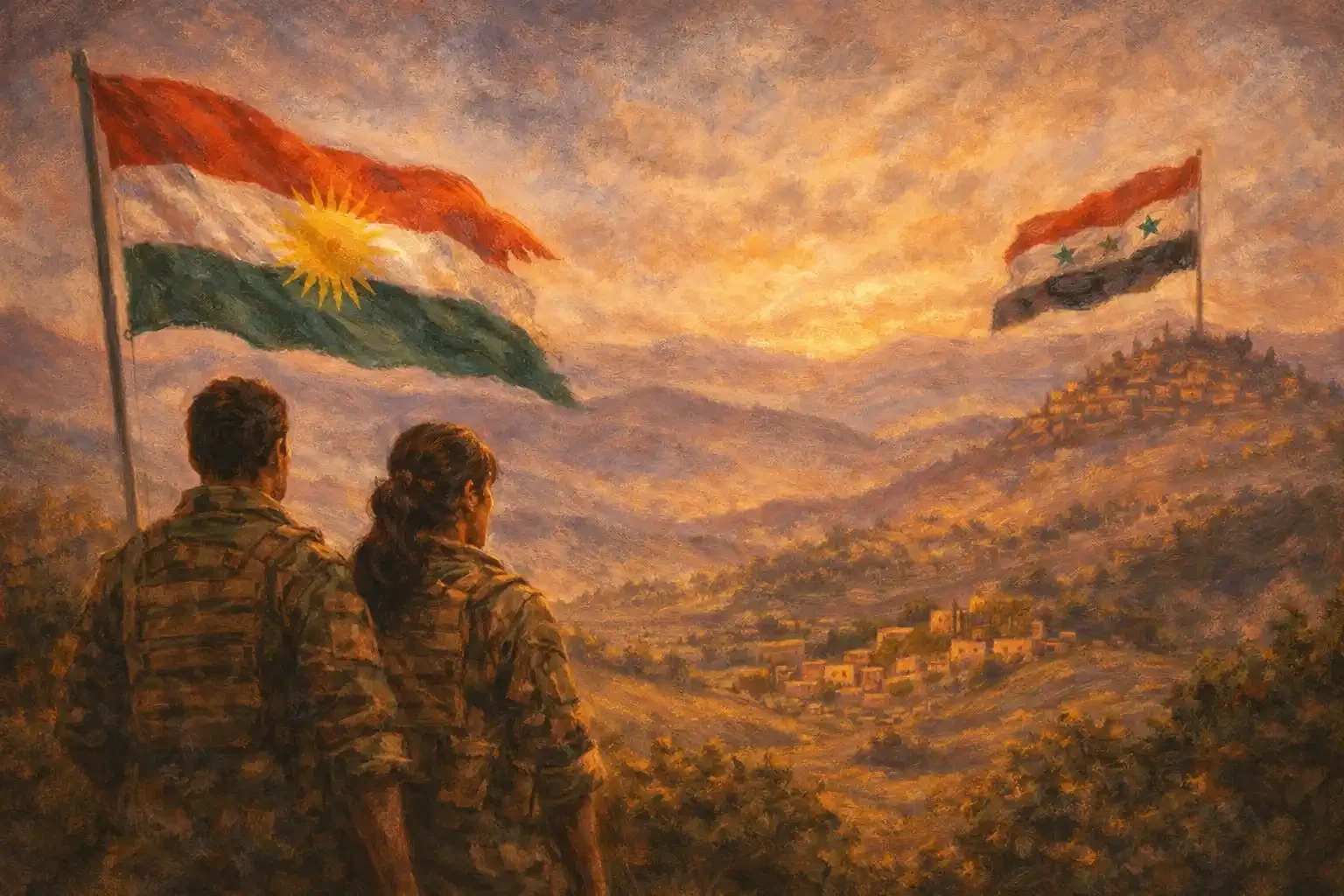
Kurdistan is perhaps the most Mazzinian struggle of them all—the fact that we have betrayed them so often is to the West’s great shame.
A federal Syria was the most consistent dream for many of us for the post-Assad era. The seemingly firm establishment of Kurdish autonomy in Rojava defended by the Syrian Democratic Forces (SDF) was, for all intents and purposes, there to stay. And even while it looked like Assad had won, it was reasonable to assume that Rojava would persist, possibly with some 1990s Iraq-style model where the region was protected by a US-enforced no-fly zone. In either scenario, it seemed that some level of independence for Rojava was an immutable fact.
However, when the Ba’athist dictator fell in December 2024 to Hay'at Tahrir al-Sham (HTS)'s blitzkrieg campaign, some tentative optimism for Syrian federalism was resuscitated. With the formation of the Syrian transitional government under al-Sharaa, what Syria could become after over 13 years of a bloody civil war could have been based on the de facto realities. But with the recent collapse of talks between Damascus and the SDF, the US’s support for a unitary Syria, and the power of Turkish influence, it appears that the second Kurdish autonomous region in the world has now been quashed, stamping out one of the remaining positives of the conflict.
You’d be hard pressed to find a more realistic example of Mazzinianism than the Kurdish struggle for self-determination. While not perfect, the Kurdish fight for their own independence has ticked many of the Mazzinian boxes, and has been an exemplar of how a militant, patriotic, and (partially) democratic movement ought to be conducted. Kurdish nationality has been extremely important when it comes to the Peshmerga’s fight against both imperialism and fascism in the region, and has proven to be a source of unity in an otherwise deeply tribalistic and sectarian country. And, repeatedly, through their own national feeling, the Kurds have engaged in battles not just on their own behalf, but on behalf of humanity as well.
The Kurds—for the most part on their own, without international support—have managed to consolidate a civil society with electoral processes, especially in Iraqi Kurdistan. Freedom of the press, of religion, of association in the context of vibrantly pluralistic civil society, are all the organic prerequisites for consolidating a genuine democracy. Elections, though hampered by their own civil war in 1994–1998 and the conflict in Iraq in 2003, have generally been free and allowed for the peaceable reconciliation of Kurdish tribalism without resorting to violence. Gender equality—while still an issue in Kurdistan—has also been a key factor of Kurdish civil society, with women serving in their own division in the Peshmerga. These democratic practices are all important characteristics for a Mazzinian movement, even if they are nascent and obstructed to some degree.
However, the Kurdish need for a state of their own goes beyond the positive, Mazzinian argument of having a clearly distinct national mission. As I commented on in my essay on Somaliland last month, the case for statehood can also be made on humanitarian grounds, given the Kurds’ status as a persecuted people. Consistently subject to forced assimilationism by Arab and Turkish nationalism, the Kurds’ national existence depends on them being able to protect themselves within their own borders. Much like the Jews and the Armenians, the Kurds have been the victims of the two main colonialist majorities in the region, both of which have persistently tried to erase them linguistically, culturally, and actually.
The most long-term example of this has naturally been perpetrated by Turkey, which has continuously sought to suppress Kurdish national expression from the very days of the Anatolian state’s founding. However, the most blatant eliminationist attempt was the Anfal genocide in 1988, where, amidst the meat grinder that was the Iran-Iraq War, Iraqi Ba’athist forces unleashed mass executions, chemical weapons, and cultural destruction on the Kurdish population. The wider campaign coincided with the infamous chemical attack on Halabja, in which over 5,000 civilians were killed.
Perhaps the most Mazzinian feature of all has been the Kurds’ willingness to sacrifice themselves for their own country as well as on behalf of others. When the US finally moved to depose Saddam Hussein in 2003, while independence was not on offer in the new federal Iraq, the Kurds still chose to fight alongside both their Iraqi compatriots and side by side with the Americans against the dictatorship and the terrorist insurgencies—rather than refusing to out of spite or interests. Similarly, when ISIS emerged as a global successor to al-Qaeda’s global terror, the Kurds found themselves on the front line of a war they were fighting not just for themselves, but for the rest of humanity. While many Kurdish cities were taken by the terror group (including, most devastatingly, Sinjar with the genocide of the Yazidi population), the Peshmerga also fought alongside the Iraqi Security Services to liberate northern Iraq, playing an important supporting role in the campaign that ultimately liberated Mosul in 2017.
However, the Mazzinian characterization of the Kurdish struggle is also complicated. While, generally speaking, exemplary, the Kurdish struggle has also failed on several levels. While Kurds have widely rejected their practices as terrorism, Kurdistan Workers’ Party (PKK) insurgent violence against Turkey has been one of the clear examples where principled guerrilla conduct has been violated. Leaving over 40,000 people dead overall, including thousands of civilians, the war between the Turkish state and the PKK has become a devastating stain on Kurdish conduct. The conduct has also been further sullied by the reports of recruiting child soldiers in Rojava by members of the People's Defense Units (YPG) during the Syrian civil war.
Additionally, despite civil liberties having flourished before, the current state of democracy in Iraqi Kurdistan under Nechirvan Barzani has become much more dire. The partitocratic duopoly between the Patriotic Union of Kurdistan (PUK) and the Kurdistan Democratic Party (KDP) has resulted in a deterioration of Kurdish institutions. Elections have continued but are still hampered by the political divisions between the two main parties. One of the most depressing failures has been in the deterioration of press freedom: both parties now maintain large media empires, complicating independent journalism, with critical journalists facing threats, accusations, and imprisonment. The judicial system—which was always quite weak anyway—has still not reached the standards of Western democracy, though there has been some progress.
This being said, the story of Kurdish failures can also be traced back to betrayal by foreign nations, including the West. Despite the ample attention shown to the plight of the Palestinians, little or no regard has been shown to the Kurdish struggle, despite its conduct and aims being objectively better. On numerous occasions, we have decided to turn our backs on the Kurds, which has often consequently led to their violent repression. For instance, in 1975, despite Iran, the CIA and Israelis assisting Mustafa Barzani’s Kurdish rebellion against Saddam Hussein, when the Algiers Agreement was signed, the support was cut off and they were crushed.
But the most memorable act of betrayal (to me, at least) was that of the first Trump Administration in 2019. After meeting with Turkish president Erdoğan, Trump reduced US forces in Rojava and left the Kurdish forces vulnerable to the Turkish military, who attacked Tel Abyad and Ras al-Ain, resulting in the forced displacement of nearly 200,000 Kurds from Northern Syria. As we turn back to Syria today, the story is, again, about betrayal. The American abandonment of the Kurds in Syria has now become complete as they push for the SDF’s dissolution and total integration into the Syrian state. Now openly admitting that it only saw the SDF as instrumental against ISIS, the US has now effectively severed any future trust that the Kurds might have maintained.
These constant betrayals by the West of the Kurds are to me a significant driver of the Kurdish failure to consolidate a Western-style democracy in the region. If the West had given the Kurds the support they needed both militarily and in the way of advice when it came to their institutions, there is little reason to believe that Kurdistan could have become even more Mazzinian. The end of Rojava’s autonomy and the end of the federal dream for Syria is something to be lamented, and continued support for the Kurds should remain a Mazzinian duty, even if hope seems bleak at the moment.

Trump running his mouth off at Netanyahu is probably justified, but the US president is really at fault for the disastrous intervention against the Iranian regime.