

Armenia’s Rock and Hard Place
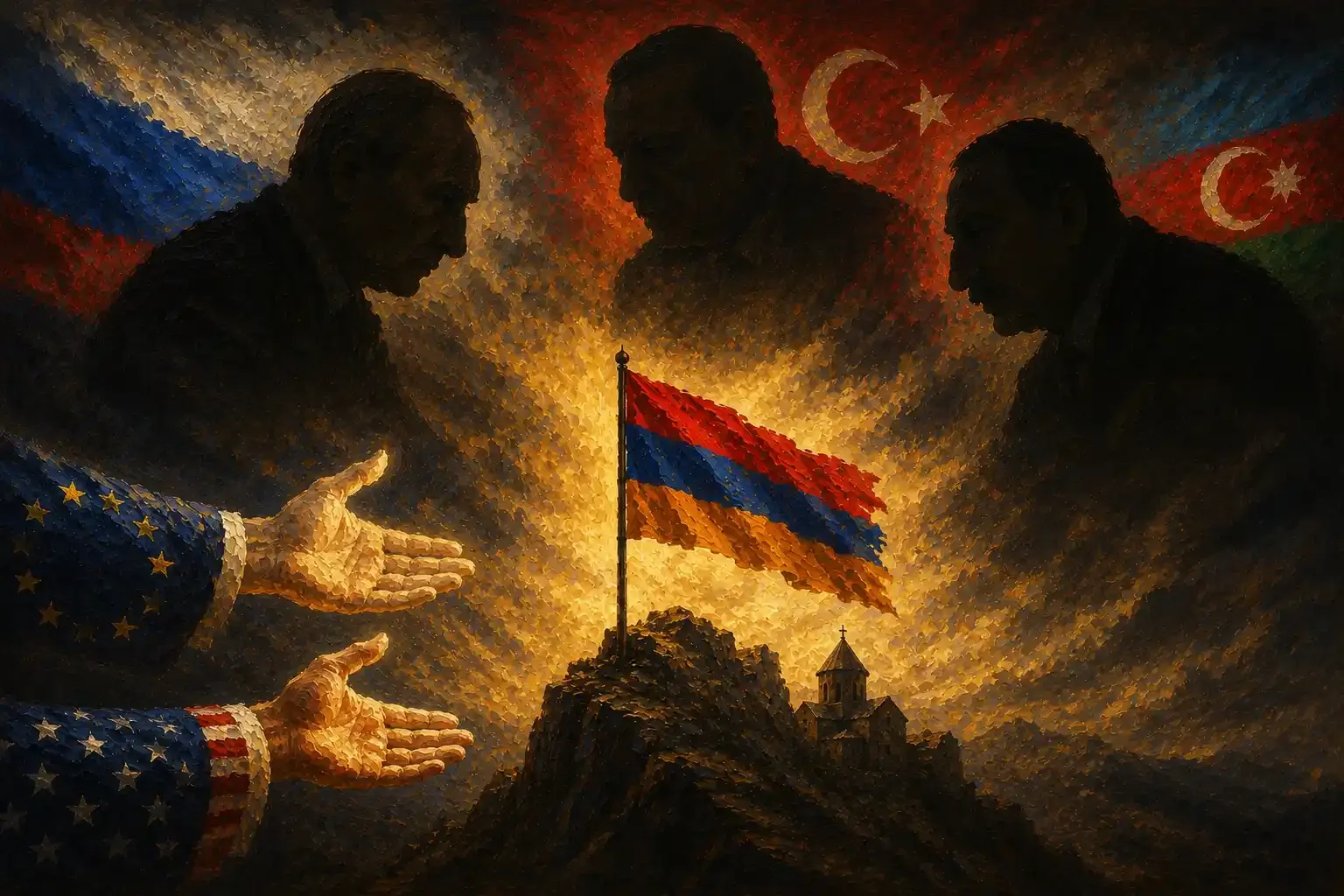
Geopolitically in a tough spot, supporting Armenia’s move toward democracy is a strong cause for our solidarity.
As Armenia’s parliamentary election season formally kicks off, it is worth highlighting the Caucasian country’s growing importance to the global democracy movement. While for many years, its neighbor Georgia has been regarded as the potential democratic prize for the region and Armenia the pro-Russian stooge, both countries have been gradually moving in the opposite direction. And though Armenia remains bound to Russia after decisions by its past oligarchic rulers and due to cultural ties, since the 2018 Velvet Revolution that saw the rise of moderately pro-Western prime minister Nikol Pashinyan, the country has now become an important ally—as well as a cause for significant solidarity—for the democratic movement.
The Velvet Revolution was a genuine democratic moment for the Armenian people. After decades of being dominated by a corrupt and elitist oligarchy through the sequential presidencies of Robert Kocharyan and Serzh Sargsyan, the revolution was an example of how it could be resisted without violence. While never a full dictatorship, the political elite's dominance of business and media in Armenia was a significant barrier to Armenia’s democratic credentials and, as Sargsyan—whose two presidential terms were up by 2018—tried to slime his way into the premiership instead, mass street protests organized by opposition leaders (including Pashinyan) erupted across the country to resist the continued oligarchic rule.
Organized mostly through social media and a decentralized strategy (where, if one protest was put down by police, another would pop up elsewhere), the Velvet Revolution remains an example of how peaceful, civil disobedience can be effective against semi-authoritarian systems. A social and democratic resistance to a media and political landscape generally dominated by the ruling elite requires considerable skill, and the success the Armenian protesters had in getting Sargsyan to resign was a significant validation of what true democratic revolution can do.
After the revolution, Pashinyan was appointed prime minister. Like with any politician, however, Pashinyan’s premiership has been mixed. While progress has been made at home, it is beyond doubt that Armenia’s international standing as a regional player has become more precarious.
On the domestic side, Armenia’s march toward democracy and away from oligarchy has been quite clear by almost all metrics. On corruption, since 2018, Armenia has improved from scoring 35/100 to 45/100 on the Corruption Perception Index (CPI) in 2025 (with a 2021 high of 49/100), with officials and leaders of the Kocharyan and Sargsyan eras having been put on trial—as well as Robert Kocharyan himself. There have also been advances in civil liberties, with Freedom House improving Armenia’s score from 45/100 to 54/100. However, the most significant improvements have been in press freedom. While never entirely under elite control, the revolution led to many new independent news organizations springing up and social media continues to be freely used among the population. There are challenges still and Armenia is nowhere near where it could be, but this is the point of being solidaristic, if only for encouragement’s sake.
Yet, despite this progress, Armenia now finds itself more than ever between a rock and a hard place on the international scene. While this was also traditionally the case literally when it came to having two of its historical enemies—Turkey and Azerbaijan—on either side of it, its warmer turn westward has also frosted the relationship between Armenia and Moscow and made its existential situation very difficult. Indeed, Moscow’s cold indifference to the Armenians in the face of threat posed by both Turkey and Azerbaijan has now put the country into a precarious position.
Russia’s lackadaisical support for Armenia during both the Second Nagorno-Karabakh War and the later Azerbaijani blockade and ethnic cleansing of the region in 2023 has been a significant shock to the system for many Armenians. Despite Armenia’s long-term membership of the Collective Security Treaty Organization (CSTO) and its deep economic ties with Russia, Armenians had always felt there was something more to the relationship. Armenians have not just regarded Russia as an ally, but also a friend due to shared Christian ties, as well as a significant regard for Russian media and culture.
However, Moscow’s regard for Armenia has, evidently, not been the same. As distrust flourishes between Putin and Pashinyan, Armenians have realized that their relevance to Russia has been instrumental at best, and given the latter’s reliance on Turkey for NATO-related leverage and Azerbaijan’s increasing strategic value as a regional energy and transport hub, Armenia’s weak geopolitical position is not that interesting for Russia’s global strategy. Hell, it probably now has closer relations with North Korea than it has with Armenia today.
But Putin hasn’t quite given up on Armenia yet either. Last month, Putin visited Yerevan for a face-to-face (and relatively cordial) meeting with Pashinyan, in which the two leaders discussed the upcoming elections, trade, and Armenia’s frozen status in the CSTO. Apart from the usual threats of interference, the Russian president also expressed the hope that Russian dual citizens would be able to vote in the elections and was concerned that many pro-Russian voices were being held in prison and censored. The Armenian premier hit back by arguing that, in light of the country’s growing freedom on social media, the problem wasn’t censorship but, according to many, the opposite. Indeed, polarization over Armenia’s future is becoming a significant issue for Armenian society, and there is little doubt that Moscow will try to exploit it during the campaign.
Armenia is at a very fragile juncture for its democratic consolidation. While it has made improvements and its greater openness to the West is positive, it is unlikely to remain so without the proper solidarity from us. Indeed, while Armenians feel betrayed by Russia’s indifference, there is no reason why the West, who also share much of these same cultural ties with Armenians, cannot step up in Russia’s place, albeit cautiously. While the Christian links give Armenia, Europe, and the West a psychological bridge that they can meet on, the vast Armenian diaspora in America can also help us pull Armenia closer and, in turn, help it in its democratization.
Russia has never been very good at making friends, let alone keeping them, and prefers to bully rather than be loyal toward its allies in its relentless pursuit of some sacrosanct sphere of influence it believes it’s owed. The Russians have failed to grasp that the reason why the United States has done so well with building NATO is not just because of its power, but because it has carefully cultivated its friendships too (something that it is unwisely destroying). Putin evaluates Armenia’s worth for all the wrong reasons: how far it can serve Russia’s geopolitical and economic interests, and right now that is not very much.
In the West, we have the advantage of using another metric: how much this country is on its way to becoming democratic. For Armenia and for us, this means that, even though it’s in a tight spot right now, its attempts to build its democracy are grounds enough to found a genuinely productive friendship that will benefit the democratic cause.

Geopolitically in a tough spot, supporting Armenia’s move toward democracy is a strong cause for our solidarity.