

The Farage-Polanski Factor
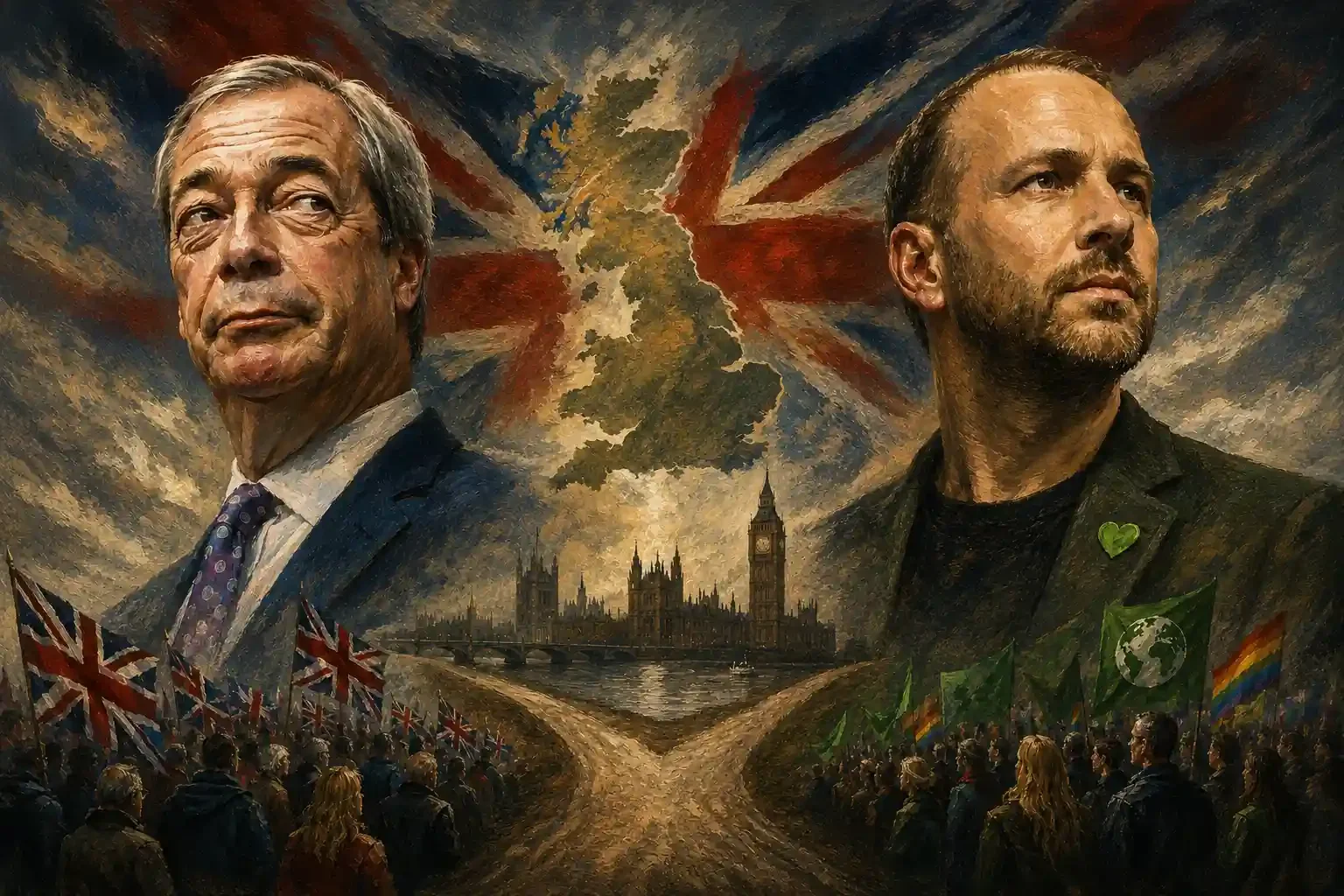
The realignment of British politics I predicted in 2019 is starting to take shape.
Back in 2019, I wrote an essay in which I argued that UK politics was heading for a deep structural shift. As Boris Johnson ascended to the premiership in the wake of Theresa May’s Brexit gridlock in Parliament, it was plain to me that the old political dynamics were coming to an end. Though the collapse of the Red Wall with Johnson’s victory in the December election was indicative of the shift, the results of last Friday’s local elections have added a little more weight to my prediction—albeit seven years later.
To summarize, my prediction was that the old Conservative and Labour divisions in the country had been exposed as defunct by the Brexit referendum and, sooner or later, a new realignment would emerge based on the new fault lines it uncovered. On one side, the Conservative Party would ultimately be replaced by a ‘National’ Party: a communitarian, patriotic party encompassing the pro-Brexit alliance across upper, middle, and working classes.
On the other side, the Labour Party would be replaced by a ‘Progressive’ Party: a cosmopolitan and socially justice-oriented party, ultimately an amalgamation of the Blairites, Greens, and Liberal Democrats. Both of these would represent the real divisions in the country that have moved away from traditional class or economic divides into something more related to the question: “where and what is home?”
While this hasn’t quite emerged as I was expecting, the bones of the change are more or less there and I think I’m entitled to some partial vindication, to say the least. In any event, if one thing has become clear it’s that, after dominating the UK political scenery for over a hundred years, the old Conservative versus Labour divisions are finally coming to an end.
Naturally, both parties have had their part to play in their own demise. The Conservative Party was not just fatigued from its fourteen-year incumbency, it was utterly delaminated by it. From Boris’s criminal mismanagement of the pandemic to Brexit’s general failure, the party is now more or less electorally finished. And given the failures to deliver on promises to voters and non-voters alike, as well as its pathological cynicism when it came to its own leadership, the Conservatives undoubtedly deserve the same fate as the Liberal Party’s in the 1920s.
Despite Kemi Badenoch’s best efforts to win back voters by trying to copy Reform’s policies, the reality is the party has not only lost the support of its habitual voters but also the support it gained from the patriotic working class in 2019; Badenoch is now a Tory Ed Miliband, representing a weak-willed Reform-lite without the trust.
Some might point to the Labour Party’s landslide victory in 2024 as evidence against my thesis, but I would argue it was the final nail in the coffin for the old-style politics. Though my expectations for Starmer’s government had been low in the first place, I did think it was extraordinary that, despite having such a long run-up toward a certain victory over a tattered Tory Party, Labour apparently had nothing ready to go when they got into power. While sympathizers may argue that the lack of progress is due to the mess that the Tories left behind (which is partly true), it still can’t excuse the fact that the Labour Party’s performance has not culminated in anything commendable, domestically or internationally.
There has been no progress, as far as I can tell, on employment, wages, or housing that is worth commenting on, and even more populist policies like student debt forgiveness have been shunted. The obvious Anglosphere center-left international alliance between Starmer, Albanese and Carney to oppose the US’s imperialism toward Canada hasn’t come about either, and Britain’s global position is now unexceptional. Funnily enough, the Labour Party has now found itself in the same position as it was in 1997: swept into government by the high of anti-Tory sentiment relying on nothing but cringey slogans and expectations.
Mourning the death of these two grand institutions of British politics might be expected—but apparently it isn’t that widespread. While there may be some desperate clinging-on by romantic Labourites in a give-them-a-chance sort of way, clearly there is no love lost between conservative voters and the Tory Party who, in the end, will mostly defect to Reform (conservatives, ironically, are more open to this kind of political change in my experience). Both sides, however, agree that the bigger parties have committed the joint sin of being both corrupt and incompetent.
The sleazy Tory government under Johnson has been effectively matched by Starmer’s whitewashing of Peter Mandelson, and the well-practiced revolving door at No. 10 prepares to swing once again as Wes Streeting, Angela Rayner, and Andy Burnham declare open rebellion. It will probably be this fresh round of PMs’ musical chairs that will catalyze the tous pourris sentiment among the UK public and push the Labour Party into the same electoral oblivion as the Conservatives.
The collapse of the Conservative and Labour parties is welcome, given their mismatch with the political reality on the ground, but what replaces them is also important. And, in this part of the realignment, it is bound to be a bit messier. There are many parts of it that are—for me at least—still up in the air.
For example, I haven’t quite yet come to a conclusion about what I think of Reform, which is likely odd given that it is the party that most people are supposed to have a strong opinion about. Even according to my own framework of distinguishing democratic populism from unpleasant vulgarism, I find the party difficult to place (though, ultimately, I think it leans more toward the latter). Nevertheless, what does seem to be true is that Reform has done a better job in terms of policy offering to align more closely with my ‘National Party’ idea and they are bridging that fuzzy line and managing to appeal to patriotic voters across all social classes.
Despite its generally Neo-Thatcherite stances on economics (which are the most antiquated of all their policies), they have managed to maintain a decent amount of SDP-style social welfarism that has annoyed the UK’s Libertarian Party on a number of occasions—which is at least a sign they are not dogmatically pro-market. However, Reform’s policies toward illegal immigration have dominated its messaging in such a way that it distracts attention (both inside and outside the party) from more unifying policies.
While the wisdom of turning your critics’ greatest weapon back on itself is strategic in the short run, the more extreme the party is on immigration, the higher expectations their voters will have. So when they fail to deliver on these policies (which they will), they won’t have any other leg to stand on with other issues. A Farage-led government will probably end up swinging to the center in a Meloni-style fashion, though Farage’s political inexperience as PM will show more quickly than Starmer’s.
The Greens have been much easier to think about. While it is true that much of the antisemitism problem in Corbyn’s Labour Party shifted over to the Green Party after Starmer’s crackdown, dismissing the Greens on those grounds alone—as the right-wing press is trying to do—will most likely backfire. If the Trump victories are anything to go on, maligning your political opponents for their bigotry (imagined or not) usually has the opposite effect, and it counts for the left just as much as it does for the right.
That being said, for all his recklessness and extremism, Zack Polanski is dealing with something that he is likely not cut out for. While it obviously takes some political skill to mitigate serious sentiments such as racism and antisemitism in your own party (something that Farage was historically quite good at, especially when his UKIP virtually ended the BNP’s appeal), Polanski doesn’t appear to have the necessary talent.
The result has been that, rather than emerge as a serious challenger to the Labour Party to appeal to the progressive center-left, his rhetorical immaturity and political eagerness has gotten in the way and made things alarming—particularly for British Jews. And their own results in the local elections have shown that, despite pitting themselves electorally as the anti-Reform, the Green Party could only occupy the extreme wing of my theoretical ‘Progressive Party’.
The Liberal Democrats, however, were quietly more successful. It is clear that they haven’t suffered a Ciudadanos-style disappearance and they remain, for the anti-Brexit and liberally-minded voter, a strong moderate alternative. Though boring, conservative, and in my view wrong on most issues, the Liberal Democrats do represent the best of the cosmopolitan worldview to present a stronger opposition to the ‘National’ side.
As I said back in 2019, for this structural shift to fully materialize, it is going to take a good few electoral cycles. Indeed, one of the great advantages of having a first-past-the-post political system is that revolutions of this sort can be phased in organically and settle in some moderate middle. This is a painful but ultimately future-conscious way of doing political change where politics is not deadlocked permanently by the vague cynicism of multiple parties.
While many of the smaller parties cite the end of the two-party system and want proportional representation, ironically they have already emerged as factions of the two nascent parties that broadly encapsulate the new British politics. Whether in time they will recognize this, I have no idea, though I think a Reform-Conservative merger is likely to occur first, with the progressive parties forming an opposition bloc later on. So, even if the UK were to switch to PR, it would still be a de facto two-party system anyway.
The UK that emerges out of this interregnum will perhaps be one that is more at home with its diminished status on the world stage. Finally being free of the expectation of its past, it could leave its Great Britishness behind, in favor of a less grandiose, but ultimately more fitting “UKism”. Regardless, there is still a long way to go until the dust finally settles.
Argentina’s irredentist expansionism over the Falklands is nothing new. But Milei’s confidence that Trump backs him is less about sovereignty and more about punishment for Europe.