
The Gibraltar Opportunity
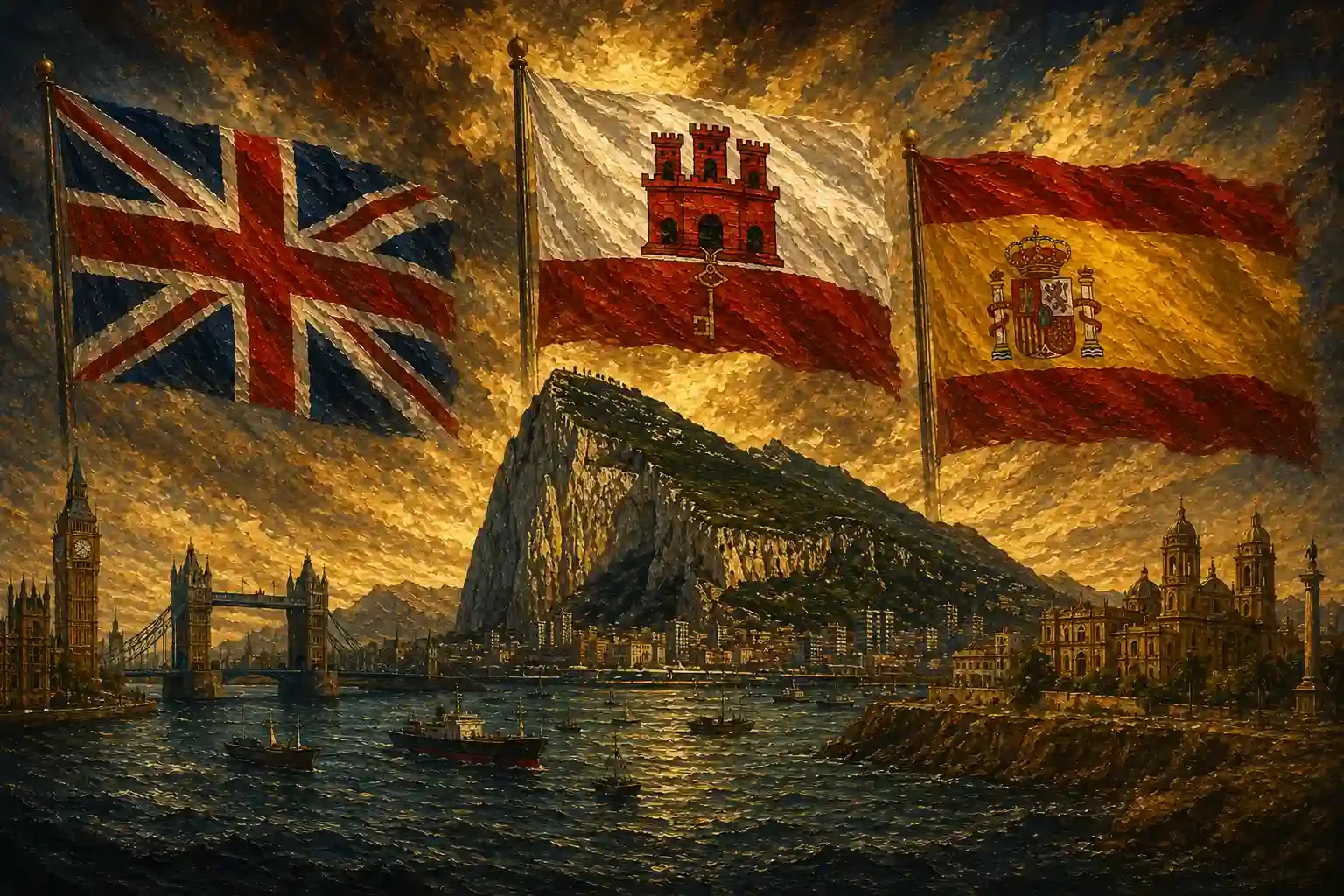
What has long been a source of tension for the UK and Spain could become the point of their future cooperation on the new international scene.
One of the more difficult reconciliations as a UK citizen aspiring to Spanish nationality is what to think when it comes to Gibraltar (even though, regrettably, I haven’t had the opportunity to visit it yet). Despite its habitual innocuousness, the tension over the Rock usually springs up when you least expect it to. While both Brits and Spaniards are content (for the most part) with the status quo, the historical fault line in Anglo-Spanish relations is something that needs to be treated seriously, especially for anyone wrestling with both nationalities and their differing perspectives.
What makes matters worse for me as a Mazzinian is that Gibraltar represents not just a clash of claims but a clash of principles. On the one hand, my strong belief in self-determination and popular sovereignty of those who call Gibraltar their home must absolutely override any irredentist claim made by Spain, regardless of my nationality. The unbroken desire by the vast majority of Gibraltarians for British sovereignty over the Rock is both sacred and unassailable, and they remain the ultimate deciders of their own destiny.
On the other hand, in line with my equally strong belief in integrating into a national community, I must also consider Gibraltar from the Spanish perspective. According to this perspective, he Treaty of Utrecht of 1713 only ceded “the city and the castle of Gibraltar together with its ports, defenses and fortifications” in perpetuity, it did not cede the actual land itself, nor its surrounding airspace and waters. It also gave Spain the right of first refusal if Britain ever decided to relinquish the Rock. While a Brit wishing to remain so need not deal with the Spanish claim seriously, as someone who wishes to move from one nationality to another, I have to think about issues from that point of view, even if it makes me uncomfortable. In short, Gibraltar for me has long represented a conflict between my own maturing Spanish patriotism and my universalist principles when it comes to democratic sovereignty.
The question over Gibraltar has not always been as complicated, however. When the prospect for the Gibraltarians was being forced into becoming part of the Spanish fascist regime under General Franco, backing the British claim was not out of the rightness of their territorial claims, but out of the principled stand against the idea of a free society being destroyed by tyranny. The handing over of Gibraltar, whose people would have seen their freedoms and way of life extinguished by the Falangist regime, would have been a scandal and a triumph of might is right over a small, self-determining people. Incidentally, we saw the contrafactual this situation back in 2019 when Hong Kong’s democracy was effectively ended by the Chinese communist regime with little international help, and it is likely we’ll see the same done to Taiwan at some point.
When the attempt by the Franco regime to appeal to the UN Special Committee on Decolonization to force Britain into handing the Rock failed, the dictator implemented a harsh blockade from 1967 shortly after the British held a referendum on cancelling the Treaty of Utrecht which was rejected by the Gibraltarian people. The blockade, which effectively sealed off Gibraltar in an attempt to isolate it, was only lifted after the Brussels Declaration in 1985, when both governments agreed to apply the Lisbon Declaration. The willingness of the British government to discuss the issue of sovereignty was primarily related to Spain's successful application to join the EEC in 1986.
With Spain’s transition to democracy, the argument did change slightly, though not overriding the principle of popular sovereignty. The referendum held in 2002 on joint Spanish-British sovereignty (which went ahead without UK endorsement) resoundingly rejected the idea with 98.97% voting “No” and, in the eyes of the Spanish government, was little more than a sneaky maneuver to undermine any future agreement between the two countries in the first place. Later, in 2006, with the proposal, ratification, and adoption of a new “modern and mature” Gibraltarian constitution, the British government argued that it had ended the question of colonial dependence and, taking it to the UN, requested Gibraltar’s removal from the list of non-self-governing territories, which the UN refused.
Since Brexit (in which Gibraltarians voted overwhelmingly to remain in the EU), and the non-inclusion of Gibraltar in the 2020 UK–EU Trade and Cooperation Agreement, the status of the Rock had been in limbo, with pragmatic approaches to ease economic trade between Gibraltar and the municipality of La Línea de la Concepción in Cádiz in the interim. With the election of the Labour government, a breakthrough in 2025 was made between the UK and the EU to facilitate the situation. The agreement, which came into effect in July of this year, has now eased crossings between Spanish and Gibraltarian citizens, removing routine immigration checks. The recent agreement between the UK and the EU has forced me to consider the Gibraltarian question again and, this time around, I feel as if there is a way of looking at it that is not necessarily trapped in an eternal conflict between historical claims and popular sovereignty, but in fact in a way that is future-oriented and, dare I say, rather revolutionary. Indeed, it could transform a point of conflict into one of cooperation.
The reality is that Gibraltar forms a unique, cultural link between the UK and Spain that is not present between other rival countries—the only other parity possibly being Macau. Though expressly British, the Gibraltarian people have developed a distinctly mixed cultural identity between the two countries, with virtually the entire native born population speaking both English and Spanish fluently, as well as their own prevalent vernacular Llanito. Due to the close economic interdependence between Gibraltar and La Línea, with workers crossing daily, the cultural interlinking between both Spanish and UK societies, despite recent frictions, remains strong. However, rather than viewing Gibraltar either a quaint demographic quirk or a point of continued tension, this cultural link ought to be exploited by both Spain and the UK as a vital bridge between the two, as well as between Europe and the wider Anglosphere, and even Latin America.
With the newly shifting international scene, old alliances are no longer what they were. The great powers—China, Russia and the United States—have flung Europe and the rest of the world in a cold, realist era of foreign policy, where they govern according to transactional might. For European and UK (perhaps now, former) Atlanticists there seems to be no alternative leading nation, unless we somehow try and make it ourselves through a more consolidated European Union as its own great power to stand firm against the threats from all three.
But the truth is this would completely miss the advantage inadvertently handed to us by the great powers in the shape of middle powers. For while dominance comes from military force and economic coercion, it can also come from multilateral alliance building that can undermine unilateral forces and use the new multipolarity to our own ends; there is no reason why a multipolar world necessarily means being trapped in distinct spheres of influence. While there is no United States of Europe with a flexible and powerful government—and none on the horizon for the foreseeable future—the European nations as independent middle powers ought to strengthen their alliances with a more international vision, but based in shared cultural and linguistic connections. For me, this was part of my support for Brexit, seeing Britain’s destiny lying outside of the European Union with the so-called CANZUK Anglosphere, and is also part of my own Iberoamericanist vision for Spain.
It is curious that both Spain and the UK have managed to arrive at very similar situations. The parities between the UK and Spain are striking enough—both constitutional monarchies with strong regionalisms—but the fact that they are also connected by the coincidence of both having been powerful imperial nations that have since declined and diminished is also significant. Though we could look at the state of both countries as simply the result of decline, the reality is they have just evolved and haven’t quite gotten comfortable with their new position.
Today, rather than great powers, they are middle powers but both with tremendous historical material behind them. Though Spain’s ambitions were constrained by dictatorship and both countries were subsequently shaped by the post-war consensus, in this increasingly archaic world, they might just have the freedom to pursue their destinies without being held back by a single hyperpower. It is true that there are challenges: Spain remains economically constrained by its position within the EU and the UK is experiencing its own economic and cultural crisis, this is not to say that with the right will and vision, they could exploit their national opportunities.
The fact that these two middle powers—who were once major rivals—have a profound connection in the form of Gibraltar by pure historical circumstance, is something that both sides could profit from geopolitically. While agreements and treaties are strong, cultural connections are often deeper because they are intensely popular. Therefore, my proposal is that Spain and the UK ought to turn every aspect of the conflictual Gibraltar question into a productive Gibraltar opportunity.
For instance, the Spanish claim to the isthmus, surrounding airspace and waters of Gibraltar could be turned into a comprehensive Gibraltar-Spain-UK security partnership with joint maritime security, intelligence sharing, and counterterrorism and organized-crime cooperation. The economic integration, which is already deep, could be developed even further with shared infrastructure and environmental management of the Bay of Gibraltar. And finally both powers could use UK-Spanish collaboration as an opportunity to promote bilingualism and preserve Llanito.
This does not necessarily need to be a special relationship as both countries have distinctly separate national destinies to pursue. But what it could become is the crucial bridge between two mature, relatively powerful democracies that could turn a former rivalry into something internationalist. The Rock need not become Spanish for Spain to benefit from it, nor cease to be British for Britain to benefit from its relationship with Spain. Gibraltar could instead become something rarer: a place where two nations can acknowledge their competing histories without allowing those histories to dictate their futures, turning irredentism utterly on its head.
Argentina’s irredentist expansionism over the Falklands is nothing new. But Milei’s confidence that Trump backs him is less about sovereignty and more about punishment for Europe.