

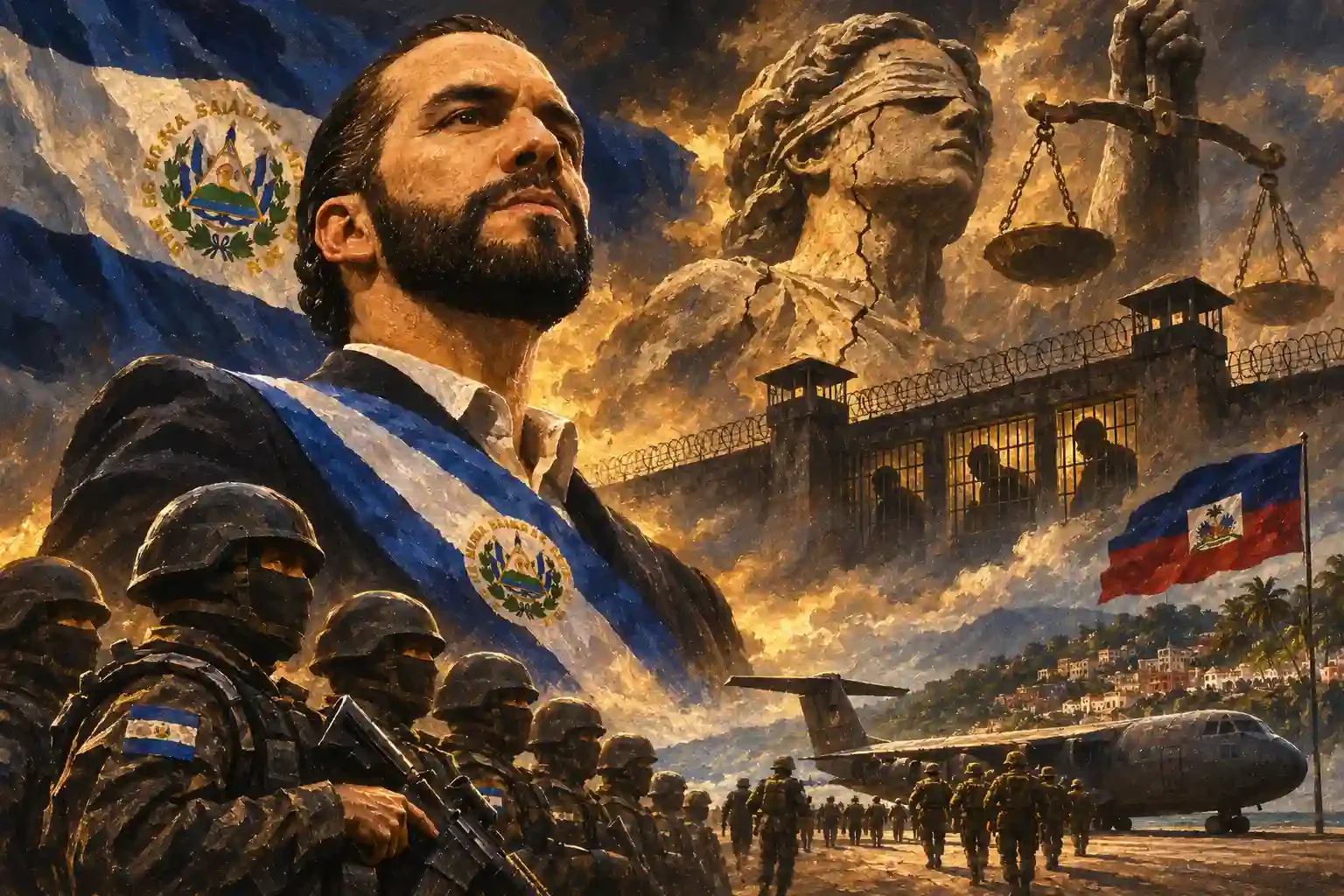
El Salvador’s deployment of 2,000 soldiers to Haiti is a worry. Though Haiti has a dire gang problem, the El Salvadoran model has never struck me as a solution, but instead a move toward dictatorship.
Sr. Bukele seems to be at it again. El Salvador’s recent deployment of around 2,000 soldiers to Haiti has obviously rung some serious alarm bells. While backed by the United States , Bukele’s operation in the Caribbean can be presented as an innocuous rescue mission, but the reality is that it marks yet another step in El Salvador’s growing brinkmanship in the region.
In the run-up to the US intervention against Maduro, I published an essay that hit out at this specific hypocrisy. I wrote that all the arguments that were being used to justify removing Maduro (and the entire Venezuelan regime) were also applicable to Bukele’s regime in El Salvador. There are a lot of similarities, even though the two situations are distinct, with Venezuela obviously still under a much more entrenched regime.
The New Mazzinian is a reader-supported publication. To receive new posts and support my work, consider becoming a free or paid subscriber.
Too many look at the reduced crime rate in El Salvador and not enough at the cost. It is true that the security situation in El Salvador has dramatically improved under Bukele’s presidency and the fact that crime—including homicides and armed robbery—has dropped dramatically, is not something that should be ridiculed. El Salvador had 6,656 murders in 2015 which was reduced to just 82 cases 10 years later. For the ordinary Salvadoran, who will always be the victim of such crime, the fact that you can walk openly on the streets of El Salvador with much less fear than before is nothing small. Application of the rule of law, to protect the vulnerable from brute force, is what makes for the moral superiority of democracy over anarchy.
But has the rule of law been actually restored or just the state become the biggest brute in town? Indeed, the cost of the rule of law in El Salvador seems to have been the rule of law.
El Salvador’s democratic backsliding under Bukele has been dramatic. Since he came to power in 2019, El Salvador has become the second least democratic country in Central America after Nicaragua (who, admittedly, has an extremely long lead), and her democratic institutions have undergone significant erosion. El Salvador quickly descended from a Flawed Democracy in 2019 into a Hybrid Regime the following year, with every appearance of falling further. During his rule through the state of exception, more than 91,000 people have been detained, often without warrants or evidence, and police officers have described being given daily arrest quotas. The human rights group Cristosal has documented more than 500 deaths in custody, none of them people convicted of a crime, and Amnesty International has warned that these abuses could amount to crimes against humanity.
Bukele has frequently used pressure and intimidation to get what he wants. In February 2020, he marched into the Legislative Assembly with armed soldiers, demanding approval of a loan to fund his security plan. The following year, after his party Nuevas Ideas won a supermajority, he used it to replace five judges from the constitutional chamber, and pass laws that allowed authorities to dismiss all judges and prosecutors who are 60 or over. He has also been devastating for press freedom in El Salvador, which now ranks 143rd out of 180 on the World Press Freedom Index for 2026. Many Salvadoran journalists have been forced into exile due to the regime’s persecution.
Perhaps the signature warning sign of imminent entrenched personalist autocracy, however, was the removal of presidential term limits in July 2025, allowing Bukele to rule indefinitely.
His record abroad has also been worrying. Honduras has repeatedly accused El Salvador of violating her waters and El Salvador continues to press territorial claims to Isla Conejo, a sore point between the two nations since 1982. Back in September last year, the Honduran armed forces accused El Salvador of invading its Pacific waters and consequently reinforced its presence there. Since Nasry Asfura won the November 2025 election and took office in January, relations have become more cordial, though I question whether that would last if the two weren’t both Trump allies.
This most recent incursion into Haiti is a step up, however. After four Salvadoran aviation technicians working in Port-au-Prince went missing after being ambushed by a gang, Bukele began threatening to use his model against them. Within ten days, El Salvador had flown more than 2,000 soldiers into Haiti with an opaque mandate and, although the Haitian transitional government has referred to it as a “bilateral agreement”, Bukele’s unilateralism seems to me to be the real thing at play here. While the Haitian gang situation is indeed dire, I think he has been itching to use the military abroad for a long while. I am skeptical that a force that large has any positive motives behind it.
We have not quite reached the point at which force against Bukele is justifiable, as it was in Venezuela and Iran. Elections are still held, and Bukele would probably win a clean one as he continues to enjoy what could well be a legitimately high approval rating (though they are no longer fair). But his trajectory will likely end up at that point anyway. With his consolidation of power in his own cult of personality, the erosion of the free press, and around 2% of the population behind bars, Bukele is emerging as the right-wing version of chavismo. His increasing boldness abroad and his willingness to start engaging in transnational repression foreshadow a further deteriorating situation.
We owe it, therefore, as Mazzinians, to support and show solidarity with the Salvadoran democratic opposition. We must also argue strongly and fervently that to deal with crime and the rule of law does not mean the erosion of it and that dictatorship is a price that is always and forever too high.
El Salvador’s deployment of 2,000 soldiers to Haiti is a worry. Though Haiti has a dire gang problem, the El Salvadoran model has never struck me as a solution, but instead a move toward dictatorship.