


With Serbia, Brazil and Israel giving us a triple whammy of major elections, I have decided to squeeze all the Mazzinian commentary into one long essay.
Rather than remain at a loss as to which election to cover this week, I thought it might be prudent to cover all three major ones in one go. Serbia, Brazil, and Israel have all faced consequential and history-defining elections and each has caught my political interest as a Mazzinian. Indeed, all of them have had some Mazzinian theme throughout as well as great significance for the global democratic movement.
Before I start, I do wish to note that even though the Bulgarian first round presidential elections were held on Sunday and were no less interesting, since the second round isn’t until 1 November, I hope the Bulgarian people will forgive me this time around for not commenting on them.
Serbia: A Complicated Democratic Revolution
The autocratization of Serbian politics under Aleksandar Vučić’s Serbian Progressive Party (SNS) has been lamentable. While he had, to some degree earlier on, embraced some Europeanism as a distant goal, his party’s influence in the judicial system and the press has long crossed the lines of being unacceptable. In fact, this year Serbia is now the only country in the EU–Balkans region that journalists have had to leave for reasons connected to their work. Vučić has eroded Serbia’s political institutions and has effectively transformed Serbia from a tentatively optimistic budding democracy into a competitive autocracy.
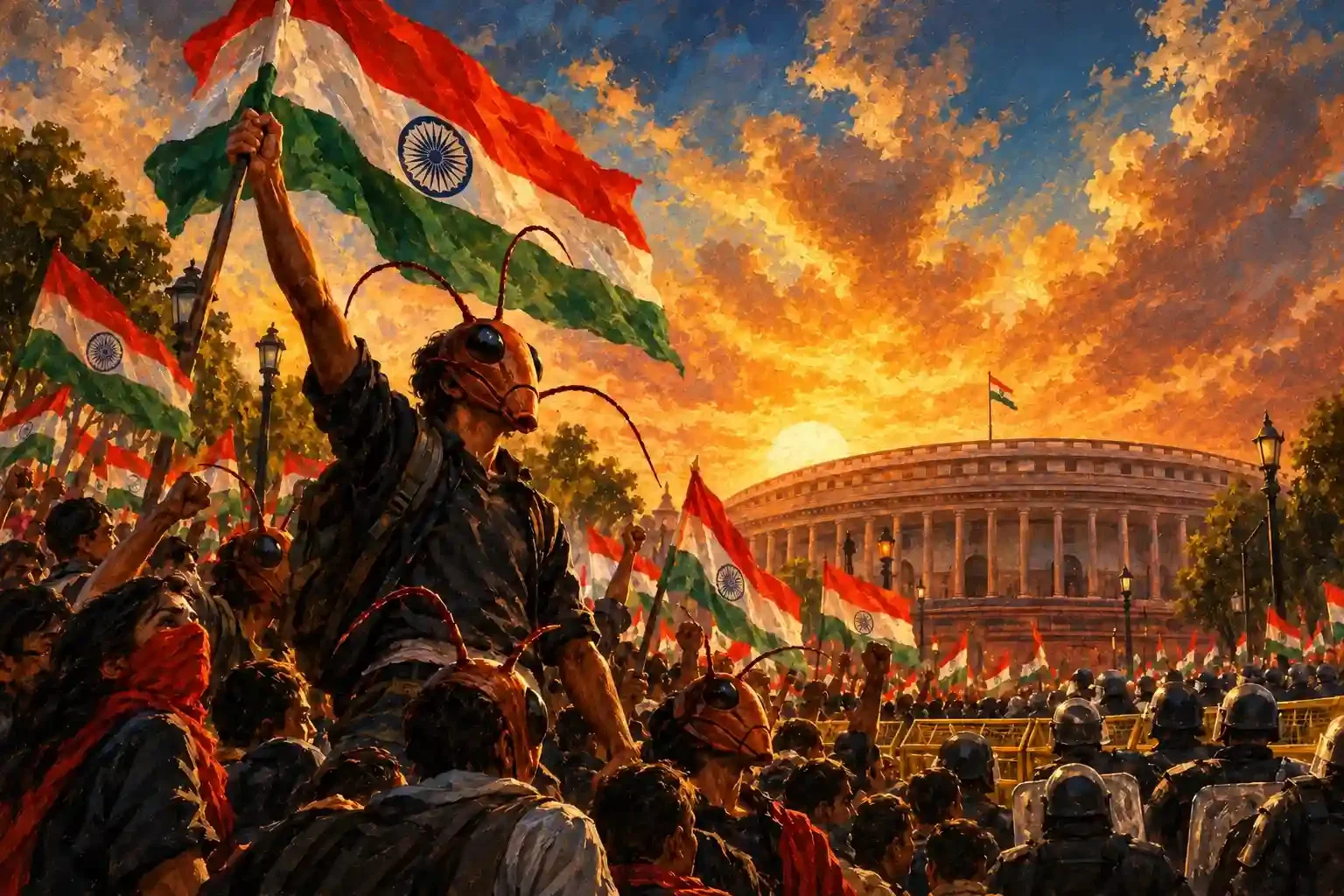
But when, in 2024, the newly renovated Novi Sad station canopy collapsed, killing 16 people, it marked the start of a democratic revolution that succeeded on Sunday in overthrowing the SNS in the National Assembly. The sheer lack of transparency and accountability following the fatal collapse was what sparked public anger, which then turned into student protests against corruption. In December 2024, over 100,000 citizens assembled at Slavija Square in Belgrade for a mass demonstration, and in that moment the student movement became a primary political force in Serbia.
There are many reasons why a Mazzinian ought to be interested in the Student List’s organization, conduct, and eventual success, not least because it provides the best practical example of how key Mazzinian principles and strategies can win out against autocratic governments.
In the first place, the pure anti-establishment nature of the Student List laid the groundwork for effective, citizen-led politics as opposed to professional politics. The exclusion of SNS party members and of members of the mainstream opposition parties is vital for creating a democratic opposition comprised of ordinary people. Also, its horizontal organization through student assemblies and plenums provides an example as to how other democracy movements could be built.
In the second place, while its pragmatism has made many people uneasy (especially its questionable agnosticism over supporting Ukraine), from a Mazzinian point of view, it was perhaps the vital factor that led it to victory. The Student List’s decision to downplay polarizing national debates in Serbia—from EU accession, to Russia, to Kosovo—allowed for unity to flourish, instead of descending into debilitating infighting; it was a wise move, as it showed it understood Serbians in a deep, compassionate way. This unity was further demonstrated by the opposition parties who agreed to stand down for the sake of deposing the SNS, setting aside party and factional interests. The democratic opposition prioritized saving Serbia’s democracy over its own views and opinions, and this was done on both sides. These are Mazzinian duties in action.
But perhaps the most modern Mazzinian trait of all was the method of resistance through the ballot box. While I have argued that, against violent dictatorship such as in Iran or Venezuela, force is unfortunately necessary, it is never the first recourse, and in countries where there exists the constitutional means, revolution must come through the vote and through civil disobedience. As was demonstrated this year in Hungary, a democratic revolution can be achieved without firing a shot, but instead through the solemn undertaking of a nation to use the mechanisms it possesses to effect change. The reason why this is genuinely revolutionary is because, as opposed to mindless ideological violence, it requires the active consciousness of a people to act out of principle, rather than interest, and do so with resolve. This has now achieved a more refined example with the Student List’s victory.
The Student List movement is not at all perfect. Internally, it has faced some major criticism when it comes to candidate purges and a lack of candidate recall based on individual behavior, and its ambiguity when it comes to its stance regarding relations with Russia is (for me at least) a reason to be skeptical, even while understanding why. And these internal challenges will become even more evident as the movement tries to define a path forward, squaring all these very heterogeneous circles. The risk is that internal suppression of polarizing debates will bubble up and split the movement, now that the goal of beating the SNS is done.
For us as Mazzinians, the Student List has provided us with the most mature example of how a democratic revolution can be achieved. Grassroots funding, guerrilla campaigning, national unity, and ordinary civic action can be successful, even against the most unfair circumstances. But its victory has also given us unsettled questions about how to sustain that unity that, for now, are left unanswered.
Tomorrow, 1 November, marks two years since the Novi Sad canopy collapsed. Amid the Student List’s triumph, it is worth remembering where all this began, and hoping that the families of the 16 who died may finally see justice.
Brazil: Two Evils, Neither Lesser
Like most presidential elections in Brazil, these ones were depressing. Having to pick between a corrupt, left-wing demagogue and a right-wing authoritarian vulgarist seems to be the best that Latin American politics can offer its peoples nowadays. But there was something about choosing between Lula da Silva and Flávio Bolsonaro that made me thankful that I wasn’t Brazilian. Indeed, from my perspective, the election was incredibly pessimistic and without a single, genuine democratic option, which is why I was mostly apathetic about following it in the first place.
Like I think most people, I was surprised that Lula managed to pull it off this time. Brazil’s economic landscape under the latest Lulista presidency has not been its best. Though employment has been steady, inflation has persisted, and the national debt has ballooned. Indeed, even the international markets were siding with Bolsonaro, seeing him as the more fiscally responsible option. Crime has persisted as a problem, and though the official homicide rate has fallen, many murders have been reported as “deaths of undetermined cause,” leading to a significant “hidden” rate between 2023-2024. This, coupled with the rise of criminal gangs, has put security at the top of many Brazilian citizens’ priorities.
But even as the international press has lauded Lula as the democratic candidate, his most recent domestic and international records seem to be pointing in the opposite direction. The general decline of Brazil’s ranking on the Economist Democracy Index since 2014 has not recovered under Lula during his third presidency, and between 2023-2024 dipped lower than even during the Bolsonaro years. Over his most recent mandate in particular, it is clear Lula has embarked on further entrenching his personalism through institutional capture: such as appointing his allies to the Supreme Court and to the Brazilian Institute of Geography and Statistics (IBGE) which rang transparency alarm bells. It is only down to the resilience of Brazil political system that he hasn’t succeeded further.
However, far more suspect are the international friends Lula chooses to hang out with. BRICS has always been a weird grouping to me, with four democracies shacking up with half a dozen dictatorships, but from a geopolitical perspective, I suppose it makes sense. Though for Lula, his rubbing shoulders with autocrats leans more toward the personal than just the strictly professional, and it does raise the question whether his allegiances sincerely lie with the democratic cause or not.
For example, he was perfectly happy to shoot the breeze with the likes of Vladimir Putin, Xi Jinping, Miguel Díaz-Canel, and Aleksandr Lukashenko at the Moscow Victory Parade last year, and his “neutral” position over the Russian invasion of Ukraine follows the familiar excuse that many who secretly support Moscow use; Lula’s Brazil is no real friend of the Ukrainian struggle against Putinist fascism. Also, his relationship with Nicolás Maduro has been “complicated” where I think he’s genuinely balancing maintaining Brazil’s dominant position in Latin America with his own warm friendship with the former Venezuelan dictator; Lula’s Brazil is no real friend of the Venezuelan democracy movement.
In short, far from the “democratic” candidate, Lula’s victory only gives him further permission to keep making the Brazilian presidency “his”.
Of course, the alternative candidate is not any better—which is why I don’t have much to say about him. After the disastrous presidency of his repulsive father, Flávio Bolsonaro seemed to me to present himself as merely a cheap copy, and a sleazier one at that. While it could be argued that Bolsonaro Senior stood for something in opposition to the corrupt presidencies of Dilma Rousseff and Michel Temer, Flávio was merely riding on anti-PT sentiment that was still prevalent throughout the country, and banking on his father’s imprisonment and US support to get the Bolsonaro dynasty back in power.
He is also clearly quite incompetent, and forgot one of the primary rules of politics: that it’s never over until it is. Treating his victory in the first round as if he were presidente-eleito—from even choosing ministers and inviting fellow Latin right-wingers to Brazil—was bound to end up badly for him. Being outmaneuvered by a seasoned campaigner such as Lula was, in hindsight, only inevitable. His subsequent flight to the US to avoid handing in his passport naturally collapses any illusion of sincerity over his presidential run. Even if the accusations of judicial persecution are true (which, given Justice Moraes’s reputation for anti-Bolsonaro leanings on the Supreme Court, they might be), fleeing injustice, rather than sacrificing yourself in the face of it, makes him little more than a pathetic coward.
Brazil has always had the destiny of being a leading democratic nation in Latin America, and it is unfortunate that the Brazilian people frequently face these types of options when it comes to choosing their head of state. Perhaps one day, a Mazzinian movement will be inspired in Brazil and bring the country together out of the sick polarization it currently endures.
Israel: A Chance for Jewish-Arab Unity?
After seeing Likud finishing as the most voted party, reading Alyssa Eisenstein’s post in the Times of Israel blog following the Israeli elections on Tuesday sparked some much-needed optimism for me, especially as a Mazzinian.
She argues that, given the high voter turnout among Arab Israelis and the significant seats gained by Arab parties in the Knesset, the Eisenkot bloc should swallow their campaign promises and pursue a coalition with Mansour Abbas’s Ra’am and the Joint List. This would not only serve to lock out Netanyahu and the Kahanist far-right from government, but it would be an opportunity to build bridges between Jewish and Arab Israelis that, under the far-right coalition, have been torn down and put further out of reach. The time has come, she argues, for developing the experiment of Arab party integration tried in 2021, for new, tentative but pragmatic steps toward Jewish-Arab unity; there is little in her post that I disagree with.
Benjamin Netanyahu’s cynical use of the far-right extremist parties (particularly Otzma Yehudit under Ben-Gvir and the Religious Zionist Party under Bezalel Smotrich) has legitimized the Kahanist terrorist ideology that had been outlawed in Israel following the Cave of the Patriarchs massacre in 1994. Sneaking in through the back door, and all for propping up the personalist ambitions of the Likud leader, Kahanism has fractured the slow, painful movement toward greater Jewish-Arab unity, propagated an anti-Zionist Jewish supremacism that has moved the country further away from its national destiny. It has also tried to destroy Israel’s democracy from the inside through its attacks on the independence of the judiciary as well as marginalizing non-Jewish civic participation through the Nation-State Law. Eisenstein is absolutely correct that under this coalition, Israel has been heading in the “wrong direction”.
The high voter turnout from Arab Israelis, however, indicates a searching voice among the Arab community in Israel to participate, even if they are still voting for their own interests. There appears to me to be a great opportunity for both Jews and Arabs in Israel to foster a new path that moves beyond the divisions of the old. I think for Israel as a nation, a potential coalition would have a lot of benefits both within Israel and for its international reputation. Stuck now with accusations of apartheid, a genuine Jewish-Arab government would help restore Israel’s image abroad, proving (rather than just Bibi’s rhetorical boasting for international audiences) that Arab Israelis participate in the country just as much as Jews do. Indeed, I’ve never understood why Netanyahu has enthusiastically pursued bolstering relations with Arab dictatorships while refusing to listen to the Arab democratic citizens of his own country. It would also foster a democratic mechanism or channel for resolving fundamental differences between Jewish and Arab Israelis, by giving the partners a place to find an actual compromise. In addition, Jews and Arabs working side by side in government would potentially allow for better understanding and allow a truly shared Israeli experience to grow.
The case of Jewish-Arab unity in Israel is also a fundamentally Mazzinian one. The point of Mazzinian democratic nationality is to transcend sectarian, ethnic, and religious differences that arbitrarily divide us and to find unity within the whole political community. There is a false tension between Israel’s founding Jewish and democratic nature, for while the ethical principles of Judaism serve as its moral foundation, these ideas are higher and more universal than the Jews as a religious group. They are the unique contribution to human progress from the Jewish people and are valuable to all humanity. In the pursuit of Israel as a nation, it is not just to be a home for the Jewish people (which it absolutely must be), but a workshop for all Israelis, including Arab Israelis, to continue that historical development.
However, Eisenstein’s is not a popular view in Israel and, as many have pointed out, is likely to either fail or backfire, with an even stronger Netanyahu-led coalition returning, as happened in 2022. It would, as Eisenstein herself points out, mean that Eisenkot would have to break his electoral promise of not working with the Arab parties. There are reasonable Jewish concerns too, based on Hamas apologist sentiment in the Joint List, that a coalition with anyone who is sympathetic to the October 7 massacre is unacceptable (a sentiment I also share). These are real challenges to the view, even if I believe it is morally the right course of action.
But I would temper it with an argument I have made about how Mazzinian governments—should one ever win an election—ought to conduct themselves, that is relevant to the Israeli case. When in a country trust in government and politicians is broken, a Mazzinian government’s success—as well as the success of the credibility of the movement—is in that government’s conduct. A Mazzinian government therefore should act through its duties first to show why citizens ought to act through theirs. In the case of a Jewish-Arab coalition, it would be an opportunity to do the same, even if the population is against it. It should take the four years between this election and the next to lead by example, and really make the effort to prove that Jewish-Arab unity is possible.
Epilogue: What National Elections Are Actually About
I have never been convinced that national elections are really about policies. It used to puzzle me, watching people who were “undecided” pore over each manifesto, examining each policy on offer, and concluding their vote accordingly. Election manifestos, though part of the formal procedure, have rarely ever been followed through by a government, and while the policies that they do carry out are important, a party hardly ever knows what it’s going to do until it actually staffs the ministries.
As we have seen in Serbia, Brazil, and Israel, national politics is about something far more abstract than a list of practical proposals: it is about political ideas. These political ideas are like great forces of nature born from a society’s pluralism and transmitted through democratic practice and represent the possible moral directions that a country could take. Elections serve, therefore, as a way of identifying what these forces are, what their principles are, and how they will define the future of the country. They are the way that a country feels its way to its national destiny.
A list of policies is important—don’t get me wrong—for it is good to see what a party proposes practically and hold them accountable to it. But they are secondary. In Serbia, the Student List has emerged as a force of opposition against corrupt autocracy. In Brazil, the elections served as a litmus test of the country’s ongoing turmoil. And in Israel, the results have put both fresh ideas and the stale old ones back on the table. But they haven’t been about what specifically each politician will do if he gets to office, and thinking that way can only end in disappointment. Instead, they have forged new ideas and new principles that have been hitherto untested, and now it is up to those leading these movements to use their skill, imagination and principles, to forge better futures; the ideas are the starting point.
With Serbia, Brazil and Israel giving us a triple whammy of major elections, I have decided to squeeze all the Mazzinian commentary into one long essay.