

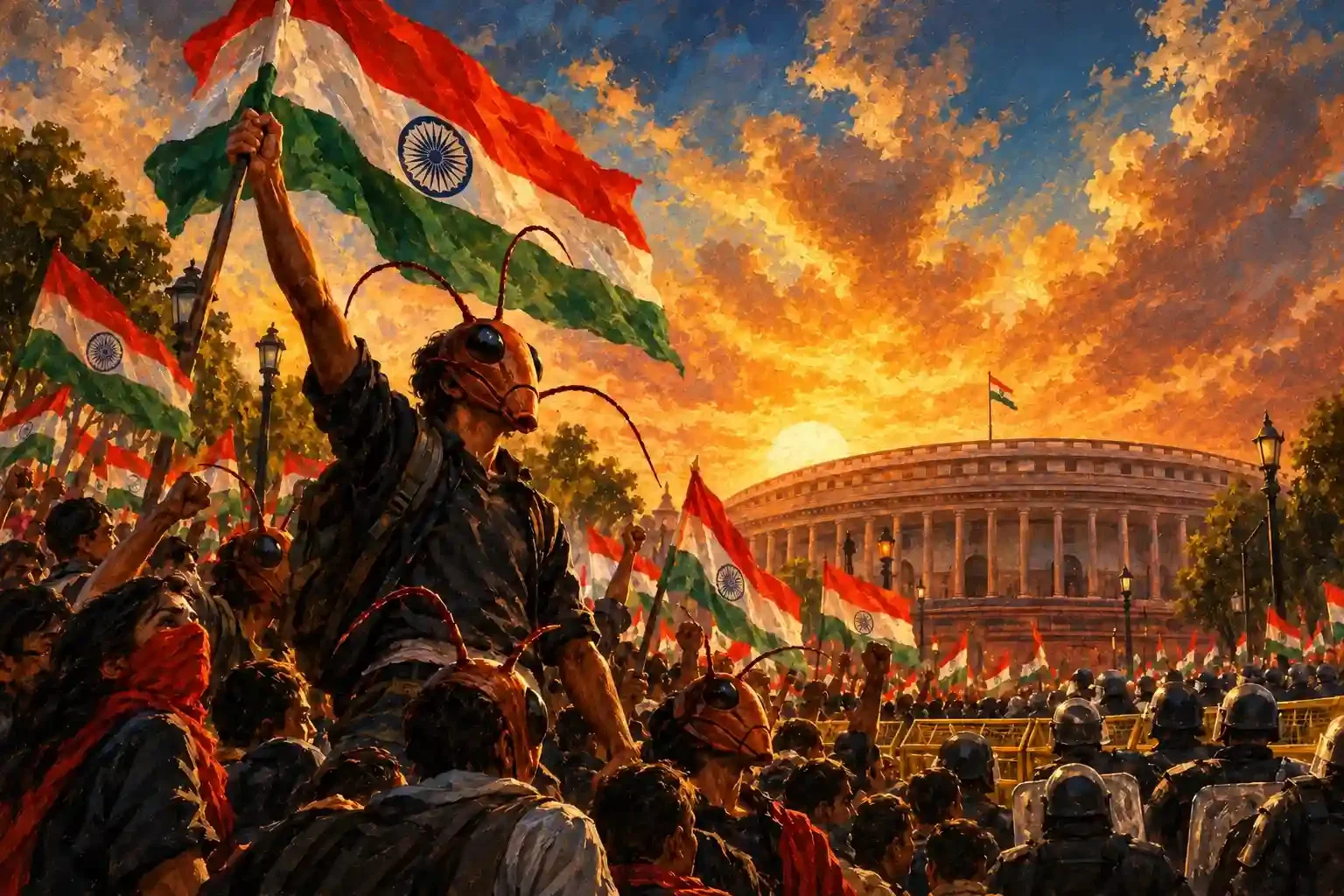
Given France’s geographical proximity, it’s little wonder why the protest-riots there are taking up most of my newsfeed. But as students in India continue to mobilize against Narendra Modi’s increasing autocratization, it seems to me that these protests on the other side of the world are evolving into something far more consequential. What started as a satirical inversion of a Chief Justice’s ill-chosen words has now morphed into a serious, democratic and unifying movement with guerrilla tactics, one that we, as Mazzinians, should study and stand with in internationalist solidarity.
The Cockroach Janata Party (CJP) has managed to maintain its meme-derived branding while at the same time challenging the Indian establishment for its treatment of the country’s youth and their economic hardship. With white-collar job growth down to around 1% and youth unemployment just over 10% (and around 40% among educated youth), the Indian economy simply isn’t working for 15–29-year-olds. So, when Chief Justice Surya Kant referred to fake degree holders and the unemployed youth as “parasites” and “cockroaches”, he was basically lighting the match that would fall on some very flammable kindling waiting below.
The remarks came after paper leaks of the NEET-UG medical exam led to exam cancellations and compensatory “grace marks” (producing mathematically impossible scores). The intense nature of these exams, as well as a severe financial burden for their preparation and the stress of the cancellations, led to over 20 students taking their lives. And, a day following Kant’s words, Boston University student Abhijeet Dipke took the insult as the satirical springboard for his Cockroach Janata Party, which, within just a week, gained 15 million followers.
The CJP held its first protest in June, staging a sit-in in New Delhi’s renowned protest square, Jantar Mantar. The protesters, armed with their placards and cockroach masks, demanded the resignation of the Education Minister, Dharmendra Pradhan, as well as ₹10,000 in financial compensation for exam candidates affected by the scandal. The CJP protesters were joined by the All India Students’ Federation (AISF)—along with other student movements—and, on 28 June, well-respected Ladakhi environmentalist Sonam Wangchuk began an indefinite hunger strike in solidarity.
On 20 July, the CJP marched on the Parliament of India—Sansad Chalo—to ramp up the pressure on Pradhan. The government responded by invoking Section 163 of the Bharatiya Nagarik Suraksha Sanhita—India’s new criminal procedure code—prohibiting gatherings of “five or more people” (except at Jantar Mantar). In an act of civil disobedience, the CJP defied the ban, and 5,000 police officers were deployed against the protesters. Tear gas, lathi charges, and pellet guns left over 70 protesters injured, while the police claimed that 118 officers had also sustained injuries, after protesters allegedly pelted them with stones. Five days later, Dharmendra Pradhan resigned and the Modi government also announced “fast-track courts” to accelerate the paper-leak trials, marking the first major victory for the CJP. On 26 July, Wangchuk ended his hunger strike.
However, things would heat up again when, in September, it was revealed that 130 million voters had been wiped from the electoral register through the Special Intensive Revision (SIR). While clearing the register of absent, shifted, deceased, and duplicate electors (ASDD) is routine, the scale of the deletion was unprecedented, dramatically shrinking voter rolls within a tiny timeframe. In response, the CJP launched its “Protest 2.0”, alleging (along with many other civil groups) that the mass deletion disproportionately targeted Indian Muslims, lower-caste Indians, and poorer, unrepresented groups more than Hindu or BJP voters. On 2 October, they called for a nationwide protest from Mumbai and New Delhi, demanding the resignation of Chief Election Commissioner Gyanesh Kumar, a freeze on the SIR deletions, and a reform of the 2023 Appointment Act for greater transparency for appointing election commissioners. The CJP’s protesters were also joined by members of the Indian National Congress—led by Rahul Gandhi—and other civil organizations who marched toward the Supreme Court and ECI offices.
Security forces carried out preemptive detentions targeting thousands of CJP protesters and effectively put New Delhi into lockdown. Metro stations were closed, and Jantar Mantar was sealed off. The police even deployed dystopian AI-enabled Ikshana surveillance vans with facial recognition technology to contain the protests. On 10 October, the police boarded a commercial flight, arresting Abhijeet Dipke and two other CJP leaders, Saurav Das and Ashutosh Ranka. Dipke, Das, and Ranka were subsequently released, on the condition of maintaining peace for one year. On 14 October, however, Das and Ranka scaled the police barricades holding up an Indian flag and were remanded in judicial custody for five days. Despite the detentions, around 2,000 demonstrators assembled at Connaught Place to wave national flags and continue the protests.
The Cockroach Janata Party has captured my admiration for a number of reasons. As someone who originally learned politics through satire, there’s something deeply inspiring in watching a joke party turn into a genuine political force, and it recalls a point made by Martha Nussbaum in her 2013 book Political Emotions, where she describes humor as essential for democratic unity. This comes across a lot in the CJP’s self-deprecating humor which (presumably as a British-born) I identify a lot with. Its tagline “voice of the lazy & unemployed” is galvanizing and subversive in a way that is more uniting than stated moral principles.
Also, as someone who has had dealings with (literal) cockroaches, I can only appreciate the power in inverting Justice Kant’s insults. The resilience of the cockroach against almost all pesticides and environments serves as the perfect symbol for the protest movement—especially since the branding produces itself. In fact, many of the tactics of the CJP who have used social media, alternative messaging apps, decoys against the AI vans, and other guerrilla protest tactics, resemble the decentralized and elusive nature of cockroaches; as the government tries to be more heavy handed, it will only make the horde harder to eliminate. These tactics remind me of those used during Armenia’s 2018 revolution.
For a Mazzinian, there is also a natural kinship between India and her democratic history and movements. Mahatma Gandhi was a Mazzinian in many of his core moral, political, and social principles and famously compared the Indian struggle for self-rule with the Italian Risorgimento. Indeed, he references Mazzini in his Hind Swaraj, and even listed the Italian revolutionary’s Duties of Man as a major inspiration. Apart from Gandhi’s strict rejection of violence, the two were very similar in combining religion and politics.
In many ways, India’s ability to cling onto its democracy in spite of appalling economic and social inequality is quite remarkable. As is being shown today with the resilience of the CJP against Modi’s strongman rule, Indians have frequently chosen to preserve their electoral system as a non-negotiable, even at the cost of faster development. Even after the Emergency between 1975 to 1977, during which Indira Gandhi held sweeping emergency powers and restricted civil liberties, Indian democracy defied the world’s expectations by making a comeback. In a weird way, this reflects a significant difference between India and the CCP’s China, which has decidedly chosen development over democracy, materialism over morality. For the Mazzinian, this democratic resilience in India should be an instant object of our respect.
This is the main reason why I have generally been critical of Modi’s government and his Bharatiya Janata Party (BJP). I have no time at all for his Hindutva nationalism, which has correlated with a substantial erosion of India’s longstanding democratic credentials and pluralistic society. Under his premiership from 2014, India’s Freedom House rating has declined to “Partly Free,” and press freedom has become a serious issue, with an average of 2–3 journalists killed a year. But more significantly, the BJP has broken with the unified and pluralistic vision of India that Indians should aspire toward, further entrenching Hindu supremacy and caste inequalities, with Indian Muslims, Dalits, and other minorities experiencing more and more marginalization. The CJP, in contrast, has directly challenged the BJP’s divisive nature, and drawn support from many social sectors in India. Indeed, it has raised the tricolor in a display of transcendent patriotism that is very Mazzinian in style.
As with many of the Gen Z protests across Asia that have emerged in the post-COVID years, there appears to be an underlying sense of duty from the young toward both their country and their democracy. Many of them feel called to defend it for its own sake, rather than out of resentment or hatred for how they as a generation have been treated. In fact, consciously or not, Abhijeet Dipke summed this call up in an interview with The Indian Express:
“Please don’t expect any kind of long-term plans from me. Please don’t expect expert thoughts from me… I’m just a guy life has thrown something at, and I’m just trying to do the best I can with it. I just want to stay as true, honest, and authentic as possible to whatever life has thrown at me, and do whatever is required of me to sustain this movement.”
It’s hard to imagine a more Mazzinian statement.
While the grievances for India’s youth are real, the democratic character of the Cockroach protests, along with their moderate demands for responsibility and transparency, reflects their seriousness about not just their own future, but that of their country and of those who will come after. This is what makes movements like this so profoundly revolutionary: not because they are angry or riotous, but because they are moderate and self-sacrificing. Looking at the protesters in France and Italy today, there is a lot we Europeans could learn from our Indian brothers and sisters.